Tuesday, October 12, 2010

BRACKET COVERAGE PART II: SLOT BRACKETS


Been real busy, I am publishing this incomplete I will add that information into part III.

In Part I, I discussed the 2 main types of brackets: Under/Over and In/Out. I finished up that discussion with a breakdown of the Nick Saban's Cone coverage. In this section I will get into two different ways of bracketing the slot receiver and discuss the run/pass technique of the people involved in bracket coverage.
I previously stated the main benefits to bracket coverage

1. Ability to coverage a good WR

2. Ability to leverage underneath and vertical routes

3. Involve simple and solid run support rules.

#3 might be one the most important concepts when it comes to bracketing. When it comes to man coverage of WR's, it takes 5 men to cover the 5 eligible men at a minimum. This leaves 6 men dedicated to playing the run. When you bracket, 6 men are put into coverage, leaving only 5 to play the run. The offensive concept that has become standard (for 10 personnel spread teams) is to run the ball versus 5 in the box. So if you are going to play the run effectively in bracket coverage, then you are going to need solid and simple rules for getting another player involved in run plays.

The great part about bracket coverage is that it is easy to do that. The starting point is to keep players out of run/pass conflicts. What is the usual indicator of a run in the shotgun? It is the mesh of the QB and running back. It is this action that can put players in conflict. Is it a run or play pass? If a player can't tell, then he is gonna be stuck in concrete not doing anything productive on the field. When it comes to run/pass issues, you need to have clear rules to keep players out of conflicts. Here are some examples and rules for eliminating this dilemma.


DUECE COVERAGE

Just like "Cone" DUECE puts the #2 Slot WR in an in/out bracket. The techniques for playing inside and outside breaks are identical to CONE. The major difference between the two coverages is the involvement of run/pass responsibilities.

The "IN" players is the person responsible for run overlap. If the ball meshes with the QB and back, this player must play run first. The FS in this coverage would be the person responsible for the play action pass to the slot WR. The Nickle player would come off later once he has cleared the run. Versus a typical bubble screen off play action, the assignments would look like this.

This is not ideal for this coverage, but these rules need to be in place to eliminate the Nickle back from being in a run/pass conflict. Versus a simple run:

Another problem route with this coverage is the Play-Action pass to the slot on a slant. It is an easy pass to complete given that the fake gets the nickle player out of the way. However, this is not a major concern. By alignment the offense will be wary of attacking the D with a slant by the #2 WR. Also, with proper stemming this look can appear to be a 1/2's, man under, quarters, or even an outside bracket look.

BRACKET COVERAGE


Bracket is an in/out slot bracket like DUECE, the major difference is that the nickle and FS switch responsibilities. These alignments are similar to robber coverage, and basic pre-stem middle field zone coverage (cover 3).

Versus a basic run the overlap and play-pass assignments look like this.

Mixing the looks is key. This game of mixing up the overlap players will cause problems for the whole offense. The linemen will have problems figuring out which player will be overlapping into the run-fit, and the QB will be confused as to what coverage the defense is in.


Friday, October 1, 2010

BRACKET COVERAGE: PART I THE BASICS

This is the first of a 3-Part series. This series is about the basics behind bracketing and the two main types that are usually employed. Part II will expand on some different variations and explain the run support principals. Finally, Part III will cover some read brackets that resemble match-up zone.

BASICS

Bracket coverage is designed to create double coverage on a single receiver. There are multiple types of brackets and various reasons to use them. The starting point for bracket coverage is to begin with its place in football.

The two main coverage families in football are zone and man. Between these two families are many voids that coaches have attempted to and are still in the process of filling. The major attempt by many coaches has been seen in the evolution of match up-zone and pattern reading. The other attempt has been bracket coverage. To better understand its place consider the pros and cons of man and zone coverage.

MAN

+Close coverage
+Disrupts timing
+eliminates throwing lanes

-Personnel mismatches
-Receivers can run off Defenders on run plays
-vulnerable to the deep ball
-Weak versus the option

ZONE

+Good for run and pass situations
+Protects against the deep ball
+Able to read the QB and break on the ball

-QB has many throwing windows
- Offenses will attack over stressed flat defenders
- You are either weak vertically or underneath.

In zone you are going to have holes in the short/intermediate or deep zones, you cannot eliminate all areas. In man you are gonna match-up problems and have trouble covering routes run away from the defenders man leverage. (ie. Inside man versus the 10 and out.) Also, a route that creates problems for both man and zone coverages is the 10-15 yard bend-in (Dig). These routes create problems that need solutions, while at the same time keeping the defense as a whole sound versus the run. Bracket coverage has the ability to defend these problem routes, eliminate mismatches, and remain sound versus the run.

The Positives to Bracket Coverage

1. Ability to double cover a good WR (eliminate mismatch)
2. Ability to leverage underneath and deep routes effectively.
3. Can involve simple and solid run support rules.

TYPES OF BRACKETS

There are two types of bracket coverage concepts:

1. Under/Over (Vertical Bracket)
2. In/Out (Horizontal Bracket)

UNDER/OVER

I have discussed examples of under and over brackets in a previous post. Essentially One person is in a trail technique covering any underneath break (inside and outside), with another person over the top providing deep support. Here a couple examples:


These are called vertical brackets Because the WR is sandwiched over and under. One man will stay low and in front while the other stays high and behind. The strength in this type of bracket is the ability to stay under any route without having to worry about getting beat deep.

IN/OUT

In/out brackets provide horizontal leverage on a WR. One defender will cover him inside and up the other will work and outside and up. This type of coverage is easy to disguise and can be employed on any receiver. To illustrate this coverage, I will use some of Nick Saban's calls for in/out coverage and some key coaching points.

If Coach Saban wants to double the #1 WR in and out with a corner and he safety he will call "CONE".


Versus a vertical route by the WR, both players essentially cover him inside and out eliminating any mismatch.


The technique of each player is crucial. If the WR runs an inside cut, the "IN" defender must play the route aggressively and take it away. In this situation the "OUT" defender would work over the top of the route and provide deep support for the "IN" defender.


If the WR breaks outside the roles would reverse. With the "OUT" defender aggressively covering the WR while the "IN" defender works to provide over the top support.


The over the top leveraging on a horizontal break is the key to allowing the other defender to play aggressive. This makes the double move routes not a concern.


In part II I will cover slot,TE, and RB brackets in addition to discussing the run play in this type of coverage.

Friday, September 3, 2010

Play Action Passes-Defending the Bootleg

I apologize for the return to the 60's hand drawn diagrams. Football season makes it hard to find enough time to write a post much less design the diagrams for it. I hope that the drawing do the job of illustrating my point.

Power running and pro-style offenses use play action passes to keep the defense off balance. One of the most difficult types of play-action passes to defend, is the bootleg. The bootleg puts pressure on the defense because it begins as a play that shows run action in one direction and then develops into a passing play attacking the defense the other direction. The bulk of the pressure comes from the offense forcing the defense to pursue one way and then have to quickly change direction and locate passing threats while simultaneously containing the quarterback. In this post I will explore defending the bootleg. First, I will explain the idea and concept of the bootleg. Then I will give a few examples of how to defend it out of cover 3 and quarters.

UNDERSTANDING THE BOOTLEG

To understand the bootleg, you must first understand the major reason that running teams use it.


#1 It punishes over-aggressive run play

The bootleg is an often used play, but derives it power the same way an infrequent trick play does. What are trick plays used for? For the most part it is not intended to "trick" the defense as much as it is designed to keep the D honest. For example, if the offenses is a big toss sweep team, they should have a toss pass in their game plan. This is important because it is needed to keep the corner and or safety from playing the toss too aggressively. If a toss team begins to notice that the corners and/or safety are playing the toss too aggressively, then they should run the toss pass. This is smart for two reason: First, it takes advantage of the opportunity to make a big time play. Second, it will take away the aggressiveness of the corner and/or safety, even if the ball falls incomplete. In effect the toss pass is the playbook to keep the defense honest. If the defense chooses to play the run over aggressively, then they will be punished by the bootleg pass.

#2 It utilizes 5 threats to attack the defense

The bootleg applies just like the toss pass, however defending it is more complicated then the toss pass. The toss pass involves one major threat and requires one player to defend it. On the other hand, the bootleg offers up to 6 threats. The more threats a play has, the more difficult it is to defend. This is the feature that makes the bootleg a great play. The majority of play action passes usually involve 4 threats. The bootleg usually has at least 5.


There are 5 Threats

1. Flat Route
2. Intermediate Route
3. Deep Route
4. Back Side Stretch route (post or dig)
5. Quarterback Run

* There is the 6th threat of the RB throwback, but I will not explore that option here, I classify that play as a trick play that punishes a defenses backside defenders for over pursuing.

The fifth threat is what separates the boot from other play-action passes. In normal play-action passes the QB sets up to read the defense, but in the bootleg he is rolling out away from flow and becomes a downhill running threat. If you are able to cover all the routes, you still have the threat of the quarterback run.

#3 It is simple to execute and change up

The boot is also easy for the offense to change up. They can run the same concept with the same reads, but be able to change up the routes. For example, they can run the boot strong and get the same look.


Not much has changed other then direction and the fact that TE runs a settle route. This route is still the intermediate read for the offense. The other 4 routes are present. The boot can be run from almost any formation as well.


Here the boot is happening out of double tight 1-back. Even though the TE (Y) and Z WR are running different routes (a push and post-corner), they are still attacking the flat and deep.


The boot can be extremely dangerous from overloaded formations like this. These sets force the defense to adjust on alignment and still maintain the ability to cover all 5 threats of the bootleg.

DEFENDING THE BOOTLEG

The first step in developing a sound defense for the bootleg is to develop rules and recognition points for bootleg strong and bootleg weak. These rules vary depending on the coverage called.

Cover 3 (Middle of the Field Coverage)

Rules for bootleg weak:

Play Side:

Flat defender----Gain Depth and break on the flat route
Corner-- Cover the deep route #3
Hook Defender---- Find and cover the drag#2
Free Safety------ Protect the middle field and eliminate the post#4

Back Side:

Flat Defender------ Check RB for throwback pass & get under the backside WR if he runs a dig#4
Corner---- Squeeze the Post to the FS #4
Hook Defender---- Become secondary contain on the QB. #5


The play side flat defender needs to gain depth and maintain leverage with the fullback attacking the flat. This is intended to allow the flat defender to help out on the intermediate route and be in a position to keep the flat route to a minimal gain. By gaining depth the flat defender give the QB the immediate read to throw the flat route. At times the hook defender can be sucked up on the run and have trouble getting to the drag.

Defending the strong side boot is very similar to the weak side boot.

Rules for Strong Side Boot


Play Side:

Flat defender----Gain Depth and break up on flat route #1
Corner-- Cover the deep route #3
Hook Defender---- Find and cover the settle route #2
Free Safety------ Protect the middle field and eliminate the post#4

Back Side:

Flat Defender------ Check RB for throwback pass
& get under the backside WR if he runs a dig#4
Corner---- Squeeze the Post to the FS #4
Hook Defender---- Become secondary contain on the QB. #5


The difficulty with the strong side boot is the settle route. The SS is put in a bind. If he is used to help on the settle route, the full back will be open and in a position to gain a good amount because of the SS leverage. On the other hand if he jumps the flat route, the hook defender will have a difficult time jumping the settle route. The strong side boot operates similar to the "stick" concept. It is covered more effectively if the hook defender is aware of the route and sprints to it as soon as he reads strong side boot.

Quarters Coverage (Robber coverage to the passing strength)

Rules for bootleg weak:

Play Side:

Flat defender----Pick up flat route #1
Corner-- Cover the deep route #3
Hook Defender---- Find and get under the drag#2
Free Safety------ Jump on top of the drag #2

Back Side:

Flat Defender------ Check RB for throwback pass
& get under the backside WR if he runs a dig#4
Corner---- Stay inside the post #4
Hook Defender---- Become secondary contain on the QB. #5


There is a trade off in this coverage versus Cover 3. Robber coverage allows the FS to play the intermidiate route aggressively, this is really the route the offense is looking to pick up a good chunk of yardage and/or first down with. By playing the FS on the intermidiate route, you can provide stronger coverage on the main two options that the QB wants to throw without relying on a linebacker that is caught in a run/pass conflict. However, the drawback is that the backside corner has to defend the post alone...... this is the most difficult route for the corner to defend. The one point of relief is that even if the post does come open, it is the last WR that the QB checks and the hardest throw to complete.

Rules for bootleg strong:

Play Side:

Flat defender----Pick up flat route #1
Corner-- Cover the deep route #3
Hook Defender---- Find and get under the Settle#2
Free Safety------ Jump on top of the Settle #2

Back Side:

Flat Defender------ Check RB for throwback pass
& get under the backside WR if he runs a dig#4
Corner---- Stay inside the post #4
Hook Defender---- Become secondary contain on the QB. #5


Again the same trade off as before. Quarters coverage allows the free safety to play the intermediate route aggressively at the expense of putting the corner 1 on 1 with the post.

Final Point

In my opinion, and you can take it for what its worth. I am more concerned with covering receivers than reading the QB on play action passes. Upon recognizing bootleg, I believe it is more important for the defenders to find and cover the threats they are assigned to cover, than dropping while reading the QB. Bootlegs are executed by finding windows, it doesn't matter if the window is behind(vertical) or beside(Horizontal) defenders. By finding and getting to the threats, the defenders will do a better job of eliminating horizontal and vertical windows.

SUMMARY

The key to stopping the bootleg is quick recognition, and clearly defined rules. Rules allow the players to know which receivers to pick up, and keep completions to a minimum. Even if they do get sucked up on the play fake, they will know which receiver they are looking for as soon as soon as they recognize pass. Any play-action pass puts pressure on the defense. Teams will use it constantly to punish defenses that are over-aggressive on the run.

Tuesday, August 24, 2010

The Numbers Game

I apologize for not posting in quite some time. I have been stretched thin, between the hectic schedule of football season and finding time for myself. I am working on a few projects which I will post in the near future (hopefully). This post will be focused on alignment philosophy, more specifically the numbers game.


WHY A NUMBERS GAME?

With the presence of 22 players on the field at the same time, football is a numbers game. Offenses use the numbers game to take advantage of the defense while the defense attempts the offense from doing so. The rules of football allow the offense to align in multiple formations, far more than a defense can reasonably prepare for. To combat this, defensive coaches over the years have developed alignment rules and principals.

Alignment can be difficult for players, which is why good coaches teach rules to their players. Also, alignment can be difficult for the coach at times. Coaches have developed their own set of principals to help themselves with alignment to various formations. What are these principals? There are varied options amongst different coaches, but more or less they attempt to adhere to the same principals. When a defensive alignment is considered consistent with a coaches' principals it is said to be "sound".

TRAINING WHEELS-- BALANCING THE NUMBERS

Football 1 on 1 instructs defensive coaches to balance numbers with the offense. New coaches are drilled on this concept by veterans. The thought process stems from the idea that the offense will attack you, if they have a numbers advantage at the point of attack. This is a good concept, but it does not need to be taken to far.

I know a coach that I worked with when I first began coaching that followed a strict "balancing" principal. I am sure most have you have heard about balancing the numbers before, for a refresher or for those whom are not sure about what I am talking about:

Balancing the defense with the offense is a simple process of counting. You start with the offense beginning at the center; count everyone aligned to the left of the center as 1. The center, the QB, and anyone even with the ball as 1/2 a person. Second, add that total up and repeat the process for the other side. Next, draw up your defense count the players on each side of the center the same way you did with the offense, remembering to count anyone aligned even with the center as 1/2. So defensively any head up nose, backer or safety aligned over the center counts as 1/2. Finally, check your numbers to each side and see if they match. If the defenses' numbers are not consistent with the offenses' numbers then the defense is said to be misaligned.

I am not advocating this is the system to determine your alignments by any means. As I have grown as a coach I have "taken off" the training wheels. This system can help a new coach line up in a manner to avoid getting absolutely killed. However, it by no means guarantees the most effective and ideal alignment.

EXAMPLES OF BALANCING THE NUMBERS

#1


This alignment is balanced and in line with the counting system. I believe this is sound alignment versus this formation.

#2


Again in this example the numbers are balanced.

#3


This is an example of alignment that fails the numbers test. The offense has 7 to the trips side where the defense only has 6. However, I am comfortable aligning this way against trips. It is not something I will do EVERY time, but I will mix it in often enough.

IS THERE A FLAW WITH BALANCING THE NUMBERS?


I think it is a useful tool, however there are many more things to consider with alignment. Disguise, pass coverage, stunts, block angles, personnel, and motion are just some of the other things that should be considered. At a certain level it is important for a coach to take the training wheels off and consider more than just balancing the numbers with the offense. I am not trying to advocate that you should not try to balance up, but that there is more to alignment than balancing numbers with the offense.

If a coach chose to only consider balancing the numbers when determining alignments, there are numerous problems they can run into. For example,

No matter how absurd this alignment is, it is balanced according to the numbers game. If I ask the question: What is wrong with this alignment? I am sure the answers that are coming to mind have nothing to do with balance around the center.


Friday, July 16, 2010

4-2-5 Alignments-Part II


PRO-I SETS

Alignments to the pro I is very straight forward and allows room for flexibility and imagination. In this part I will focus on base alignments with a few other options.


CALL: TITE-2

The front and secondary both declare the strength the same way in this alignment. The TITE call puts the 3-tech towards the TE, the strong DE aligns in a 6. The backers align in 30 techniques. Some people argue that the backers should align in their gaps. ie, the RB should be in a 10. However, in the 30 alignment the RB can still defend his A-gap and is in a better position to play outside and off-tackle plays towards the TE.

The secondary calls "read-left" and sets the SS and FS in coverage to the left. The strong safety aligns 5-7 yards outside the TE and about a hard from the LOS. Also, the SS cocks his stance in and places himself perpendicular to the LOS. This alignment allows him to get under routes by the #1 WR, have a good angle to force the ball, and make it difficult for the WR to crack block him. The last reason needs further explanation. Teams like to run outside, will get tired of the SS forcing the ball back inside. So, they will attempt to crack him inside in order to get around the edge.

Making the crack difficult is accomplished by this alignment for a couple reasons. First, his back is turned to the WR. The receiver cannot legally block him in the back. Second, if he does attempt to crack block him, the crack will occur near the LOS. By making a crack happen at the first level, the corner is free to replace the SS as the force man. If the crack occurred further from the LOS, the corner could not replace as quickly, because he has to respect the crack and go. By attempting the crack at the first level, the threat of the crack go is eliminated. It is difficult to fake a first level crack and turn it into an effective go route.

The WS aligns in a postion to force the edge to his side and play the cutback on plays toward the TE.

VS TWINS

CALL: TITE-25

Twins is a formation where the front and secondary call the front in opposite directions. The AB is aligned in 10 in the diagram, but he could just as easily be aligned in a 30, it makes little difference. The SS and FS align to the twin WR's just like they would versus the spread. On the TE side the corner is shown close to the edge playing force. The WS could just as easily be there. The alignment each year might be different depending on the type of corners and WS you have. Below is a diagram of TCU from this past year aligning to twins.

Versus the Full-back set strong


Here the backs slide over and WS comes up into the nest, this call a "scoot" adjustment. Everything else is the same as regular pro-I alignment.

FLEXBONE


Here the alignment follows the base rules. The strength in the diagram is arbitrarily to the left. Versus the balanced front and the motion based nature of the flex-bone, the free safety will declare the read-side upon motion.


GOAL-LINE

The last view diagrams are an example of how TCU aligned versus Clemson principals. The particular scheme they employ is not really special to the 4-2-5. I am showing it as a way of understanding how the particular positions are aligned.


A safety has replaced one of the corners on the right edge. The DT's are hard A-gap player, and the backers are cheated-up into their gaps. There are two safeties to each side aligned on the edge and behind. The corner in the middle is adjuster who moves with any motion by the backs. This allows the front to stay relatively focused on the play by leaving adjustments to the corner. The next diagram shows the formation after motion.


Thursday, July 8, 2010

4-2-5 Resources

Blitzology posted links to some playbooks for people interested in the 4-2-5 defense.

Also, I have included links to two other files.

First, is a link to a 1997 article by Gary Patterson describing some of the principals and philosophy behind the 4-2-5. If you have not read it, it is a short but worthwhile article on the ideas and benifits that are behind the 4-2-5.

Second, is a link to an AFCA article by David Baliff, the current head coach at Rice University. He is the former D-line coach for TCU and Head Coach at Texas State University (formerly Southwest Texas State). He currently runs and has run a very similar scheme to Patterson's. This article details some blitz and alignment principals.

Third, is another article by Baliff where he outline some technique and schemes with d-line twists. The information on technique is excellent as well as the simplicity behind the twist game terminology, this is typical wording to anyone familiar with the 4-2-5.

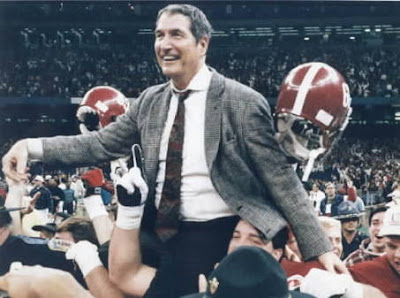
Gene-Stallings- Football Philosophy

Gene Stallings was a great coach. He believed that the first step in developing a winning team began with developing a philosophy. He had very clear views of his philosophies on both offense and defense, and was insistent upon sticking to his philosophies at all cost.

OFFENSE

His stated "On offense I want to score, I want to score a touchdown, I want to kick the score, or move the ball far enough that my opponent has to go 80 yards to score." He was running the veer option one year, and lost a bowl game due to numerous offensive turnovers. In the off-season, he decided that his team needed to move away from the option. He believed that they could dedicate no more time to perfecting the mechanics of the offense, and that even the significant time they put into the previous season, was not enough to prevent these turnovers. He made this bold move because he believed that the option went against his philosophy. The schemes that a coach develops come after the development of a philosophy. Stallings calls this the "Method."


DEFENSE


Stallings impact and emphasis in football was defense. More of his time was dedicated to defense than anything. His philosophy on defense was simple: "I want to prevent my opponent from moving the ball effectively." This is pretty obvious, but he believed that not everyone ascribed to this philosophy. When it came to developing a method for his defense he believed he had to create a coordinated defense. "I want the front to coordinate with the force, and the force to coordinate with the coverage." For him, football was a game of forces, and that if he could force the ball well and defend the end run effectively, then it would make it hard for the offense to move the ball effectively.

On defending the end run, he believed that there were three key parts. These parts have become central to the development of any effective pass coverage scheme. These three parts are:

1. A player to turn the ball back inside (run force).
2. A player to play the cutback (alley)
3. A player to play the play-pass.

This is all you need to defend the end run. If each person does their job, the offense will not be able to run the ball outside. The first two parts are obvious, the third was not as much in the past. During these days the pro-I was the norm. Teams tried to establish the toss game. If the toss was getting played aggressively, then they would employ the tricky toss-pass. This play was not designed as much a "trick-play", as it was a play to keep the defense honest. The third part of defending the end run, was the player responsible for defending against these tricky plays.

He was insistent that his players understood the principals of run force as well. It was important that each of them knew their responsibility and played their part. He did not want two people forcing the ball or two people playing the play-pass. For example, if the alley player got outside with the force player, he would ask him: "Do you think that the corner can force the ball back inside?" The players would say "yes". He would then answer by asking "Then why are you trying to force the ball?"

He changed his pass coverage by changing his forces. If he was in pistol force, the corner was forcing the ball, the safety was playing the pass, and the linebacker was on the cutback. This was 1/2's coverage. He could control these forces independently on both sides. This was an early form of the split-safety coverage that is employed today. If the call was rifle force, the safety played the force, the corner was on the play pass, and the backer played the cutback. This is the same force package that modern quarters teams employ. Finally he would have box force. This was backer force. The safety played the cutback, and the corner was on the play pass. This force was used on the weak side of cover 3, and man coverage.

Stallings was also a proponent of press-man coverage. He believed that if you sat in zone, the offense would be able to move the ball effectively with short controlled passes. He would talk to coaches about getting the fear of getting beat deep out of their heads, and make a commitment to utilizing aggressive man. I am sure that most defensive coaches are still scared of press-man coverage. Stallings was probably a little uncomfortable too. However, he knew it was something he had to do in order to prevent the offense from moving the ball effectively.


BECOMING A GREAT COACH


Another part of his belief structure was on being a great coach. To be a great coach you have to be a great teacher. And to be a great teacher, you have to be able to "speak with authority". He preached the basic parts of effective teaching such as accountability and attitude. However, he stressed another, sometimes overlooked part of the job. Speaking with authority meant you were completely knowledgeable about what you were talking about. If you did not understand something fully then the players would be able to see through that.

If you are an offensive coordinator, you better know the passing concepts, blocking schemes, and the various mechanics of each position in and out. "If you don't, then you are cheating your players." The same went for defense. Also, if you were a position coach you better know that position inside and out. A great coach should know it to the extent that they are educated about it in schemes that are not part of the ones they coach.

The head coach was no different. Stallings believed that the head coach should be knowledgeable about all the aspects of football. The head coach should know offense, defense and the kicking game in depth. If not, you are cheating the team. This is crucial, if you are an offensive coach that becomes a head coach. How can you speak with authority to your defensive coordinator, about an issue you have with his scheme, if you don't know defensive football in and out? This what he believed was necessary for speaking with authority. When a coach gets up to the board to talk football, he needs to be able to speak with authority.

Finally, Stallings explained a simple process for getting to this point. He believed that a coach should dedicate one hour per day to studying football, any aspect of it. This is a time where you don't take phone calls or any other type of distraction. You can read about football, watch films, talk to others whom are knowledgeable about football, ect. If you do this consistently, after a few years "you will be an authority on any aspect of the game." This is what I love about reading football blogs, it is a time to dedicate yourself to getting better at the game.

CONCLUSION

This is just a snapshot of Gene Stallings' Philosophy. The important thing to take away from this is the commitment he made to sticking to it. He altered his offensive schemes and defensive coverage to stay consistent with what he believed. This commitment was a big part of his success. Perhaps, the biggest key to becoming a great coach was doing the things necessary to be a coach that can speak with authority about any aspect in the game of football.

This information was gathered from the 1992 and 1993 COY Manuals.