Showing posts with label Zone Coverage. Show all posts

Friday, January 6, 2012

Exploiting Situations: West Virginia vs Clemson


Dana Holgorsen has earned a reputation for himself by fielding offenses that light up the scoreboard and put up monster stats. He doesn't do this by playing small ball; picking up a few yards here and there. He does it by creating explosive plays. Big plays happen when the offense exploits a weakness in the defense or a defender or two blow their assignment. In the first quarter of the Orange Bowl, the West Virginia offense completed a 34 yard pass to a wide open receiver. This play is an example of how the offense can create explosive plays by exploiting a weakness in the defense.

The play that will be analyzed can be seen here:


This play was created by exploiting 4 primary factors:

1. Situation (Down and Distance)
2. Ball Position
3. Formation
4. Personnel

The first factor is probably the biggest one on a football game meta-level. The final 3 can be chunked together into one thing.

EXPLOITING THE SITUATION

In a previous post I covered down and distance strategy. The goal for the defense is to get the offense into a manageable 3rd down situation (3rd and 7 +). The way to do that is to limit gains on first down to 3 yards or less. This is why the running game is so important to the offense because it can keep the offense out of difficult third down situations.

This play occurred on first down. It is in Clemson's best interest to keep the West Virginia offense from gaining more than 3 yards. In order to do that they can't be overly worry about the big play. This does not mean you allow the big play, but that you get defensive calls in that are more aggressive towards the run. Because of this principal, Clemson would most likely be run conscious in this particular situation. "Run Conscious" meaning probably in a base front with zone coverage.

BALL POSITION, FORMATION, PERSONNEL

These next three factors work together.


Ball Position

The ball is on the hash, it is on or around the hash approximately 80% of the time. Modern defenses are even more concerned with ball position because opposing offense have become more creative in utilizing it. The hash is such a concern that many defenses will call coverage strength to the field the majority of the time. One of the few things that will keep a defense from calling its passing strength to the field is trips formations.

Formation

This brings us to our next factor. Holgorsen uses a trips formation on this play. Defending trips involves a varied plan of attack in and of itself. When you combine the formation with the ball position a very particular set of circumstances need to be considered. First, the trips are into the boundary. This is not a common occurrence for the defense. Most defensive trips schemes are built on the premise that the offense is running trips towards the field. Boundary trips is in the back of the defensive coordinators mind, but does not call for concern like field trips does.

How does boundary trips effect the defensive thought process? First there is one WR with a ton of field to work with. This makes you think twice about putting a corner one on one with him. Second there is more space to work with for outside running plays, option or stretch being the most probable in this situation. Third, the constricted area that the 3 WR's have makes many trips side passing plays not likely. Finally, the offense can still out-flank the defense albeit with less space. This is still a cause for concern, because if not properly aligned, the defense can be hit for a 5-10 yard running or passing play easily despite the lack of space.

Because of this the defense still needs to align properly to avoid getting out-flanked while being concerned (even more so) with weak-side (field side) runs or passes.

The defense has the classic trips problem, but magnified to the open side. Which side has priority? The trips or open side? One of the things some defenses factor in is the alignment of the back. However, in this particular formation this is no help, because he is aligned directly behind the QB.

Personnel

Finally the personnel is a cause for concern. In this particular play one player is the main concern. The single side WR Stedman Bailey #3 does not have the most catches on the team, however, he leads the team in yards per reception, yards receiving, and touchdown catches. It doesn't take a rocket scientist to figure out that he is doing it on big plays. Bailey's alignment is a concern as well. He is in a position to run a quick out, comeback, fade, or anything else. His alignment opens up a large range of potential routes.

Putting it Together

Factoring all things together it is probably in the defense's best interest to free the field side safety up and have him help on the run and with coverage on Bailey. Calls like Solo or Mable would not be ideal for this situation.

THE PLAY

Clemson's Defense

They opted for a basic 4-2 front alignment and the backers are not overly cheated one way or the other. This is considered typical for this formation. The secondary is showing a two shell, which could mean anything. This could be a disguise for any number of things. The alignment that stands out is the boundary side corner. He is aligned outside the #1 WR 7 yards deep. He is not likely to come down into a 1/2's concept. Plus if the corner was playing a 1/2 concept he would need the field side safety to cover #3 vertical or a backer( vs this play that would not have been a good idea either). He appears to be getting ready to bail out.

They end up playing some type of 1/4's concept to the trips side with a 1/2's concept to the open side (could be a bracket).

WEST VIRGINIA'S PLAY

It appears that the QB might have been (don't know for sure) looking towards Bailey 1st on some type of Air-Raid "Choice" concept.


Upon seeing the double coverage, the QB would work his progression back to the trips side. This is where Dana Holgerson's play call most clearly exploits the situation. If he gets Bailey one on one, then great, throw him the ball (he actually still gets behind the double team). If they double cover him, then he has a play that will exploit the likely coverages that a defense would run on first down.


If you look at the routes, this play type can be effective versus most first down defensive calls. It really hurts Clemson's quarters concept.


The H vertical route draws the Strong Safety's attention. He cannot play the post route by the Z because the H would be wide open. The corner cannot get into coverage of the H or Z because of his outside alignment. The only thing the defense could have called to be solid versus these routes is a 1/4's bails (pure zone). That is not a sound call on first down.

This play makes the corner irrelevant and forces the SS to make a decision. He chooses to cover to the H (wise choice) and allows the z to come open on the post.

The defensive coordinator had to recognize the possibility of these play types, so he must of had a plan for them. Many defense's use backers to play wall technique on the first route to work towards the middle of the field, this forces QB's to throw high balls that give DB's time to break on it.

So where were the backers?

Its was a first down situation, and the offense showed run first. The play action kept the backers from assisting in coverage. You can't blame the backers either. Its first down, Division I linebackers are taught to play run first especially in a 1st and 10 situation.

The play action draws the backers up and because of the coverage called the Z is able to get wide open. What other zone coverages could cover these routes effectively and keep the defense from covering Bailey 1 on 1? Besides pure zone quarters, none really without linebacker help

I am not gonna draw them all up, but think about it.

1/2's: Who is gonna cover the post? There is 3 vertical routes to stress the safeties.

Cover 3: The H is gonna open on the seam with no-one to jam him, unless you play a mable tech and drop the SS down. I already discussed that this is a bad idea considering the other things the offense could do in this situation.

Special: Same problems that Clemson had, the SS is in a tough situation.

CONCLUSION

This play shows how the defense can be manipulated on 1st down. Given the situation, formation, ball position, and personnel the defense will be influenced to do certain things. If the offense understands what the defense will do, then they will be able to create big play opportunity. This shows why Holgorsen has been successful


Monday, May 31, 2010

Defensive Fundamentals: Training the Eyes

In my post about "Pattern Reading vs Spot Dropping" I briefly talked about the importance of training a defenders eyes.


When making any type of "reads" in football, it all boils down to the eyes. There needs to be methodology to where a players eyes are supposed to be looking and how they respond to what they see. The more clear we can be with the progression of a players eyes, their ability to diagnose a situation, and trigger the appropriate response; the better we can all be at coaching defense.
Determining a progression for the eyes to follow coupled with a set of movements (responses) is the key to effective defensive football. All positions on defense can involve this principal. In this post, I will look at different positions and describe possible eye movements and progressions.

Why the Eyes?

The #1 mistake on defense is a player having his eyes in the wrong place. No matter how well a player is taught to shed blocks, break and intercept passes, or form tackle, it can all be for nothing if the players eyes are in the wrong place. The various techniques we teach to our players are intended to be used during a particular situation. Few techniques (like back pedal steps) are used on every play. The majority of these techniques are situational. What good is squeezing a down block on a pass play? Or dropping to the flat on a run play? Neither of these techniques would be good because they are inappropriate for the situation.

What tells a player the appropriate technique for a particular situation? Some type of visual cue. Players execute their techniques more effectively when they begin to make the connection of a visual cue with the desired technique to execute at a faster rate. The single most important point to training the eyes, is it will allow a player to execute their various techniques in the appropriate situations at a fast rate. This type of mental/physical conditioning process is what allows players to play fast, and the key to consistent execution come game time.

In this post, I will look at 3 different positions and describe possible eye movements and progressions.

1. Middle Field Coverage-Free Safety

Run: Alley Player Inside Out
Pass: Middle 1/3

I have discussed part of this technique already, but I will begin here with initial pre-snap eye keys. Player should align in the middle of the field and then get his eyes on the center or most visible offensive linemen. At the snap the FS should get into a backpedal and read the center for run/pass.

Eyes on Run Plays : If the linemen attacks aggressively forward, the safety should immediately get his eyes in the backfield to diagnose the direction of the run flow. Upon identifying the flow, he should Plant, point, and drive towards the ball carrier on an inside out path. On his pursuit he should keep his eyes on the ball carriers inside hip and maintain vision on a path that has the ball carrier inside and in front of him.

Eyes on Pass Plays: When the linemen key works backward (indicating a pass) The FS should maintain his backpedal and immediately get his eyes on the QB's non-throwing arm. He is looking for the long-arm of the QB. Upon Reading the long-arm the FS must intercept the pass with his eyes. This means he needs to locate the place on the field he needs to break to in order to make a play at the pass. Upon locating this position he should take a straight line to this spot. While in pursuit he should swivel his eye's from his aiming point back to the ball.

---- This is a simple progression of eyes that will keep the Safety in proper position. Must busts that the free safety makes will be one of two things. A. The player did not have his eyes on the proper place. B. A misread will prevent the player from executing the proper technique.

2. Press-Man-- Corner

After aligning properly inside, the corner will put his eyes on the inside hip of the WR. The corner is a dedicate pass player and will only play the run if #1 he FEELS the WR trying to block him (a good WR will run him off, so I don't plan for this too often) or he hears his FS or coach yell "Run, Run." Baring those non visual exceptions the corner will have eyes on the inside hip initially. He has 4 different techniques to execute in man coverage.

- Release
-Jam
-In-phase
-Out-of-Phase

The release phase begins with initial steps by the WR. During this phase the corner will use slide steps to move vertically and replace steps to move laterally. These steps are used to keep in the proper inside relationship with the WR. The corner is keying the hip because it is a true read for him. The WR's feet, chest, and head are all more misleading than the inside hip. What he is looking for from the hip, is for it to commit. When the hip commits the corner is now in the jam phase. When the hip commits it turns and breaks a 45 Degree barrier. Upon reading a commitment of the hip, the corner gets his eyes on the near number (pec) of the WR and jams it with his off hand while opening his hips. The opening of the hips and off-hand jam are designed to keep the corner on top of the WR.

For example, we will assume the WR releases outside. Once the initial jam is done, the corner must assess his position on the WR. Can he see the near number of the WR or not? If he can, he is in-phase, and his eyes will focus on the WR's eyes with his peripheral vision on the V of the WR's neck. If the WR's eyes turn to look for the ball, the corner turns to play the ball as well. If his eyes and V of the neck turn back, then the ball is under-thrown. The corner needs to basketball block the WR from coming to the ball while making a play on it himself.

If the corner cannot see the near number after the jam phase, then he is out of phase. His eyes will not leave the WR until the whistle. He will key the WR hands. If the hand move to catch the ball, then the corner will wait for a "1000-1" count then rake the WR's hands.

----------- Mistakes like opening the hips the wrong way, wrong hand on the jam, getting beat off the line, and allowing an easy catch are all problems that start with the eyes. Corners get beat inside on slants when their eyes migrate up to the WR's chest. Many catches are made when a corner is out-of phase with a WR and then peeks back to find the ball. These techniques are not very effective if the eyes are undisciplined.

3. Defensive end in a loose 5 technique

C-Gap Player
Technique: Squeeze on down-blocks, does not get reached, Spills the ball on pulling plays, Outside contain on pass.

After he aligns outside the offensive tackle the end will key the feet of the offensive linemen. He is trying to identify which foot the linemen will step with.

If the linemen steps with his inside foot, he is trying to down or scoop block another defender. Upon reading this the d-end should step laterally with his inside foot and squeeze the down-block. While squeezing down the line his eyes should peak down the line for any pulling lineman. If a pull is coming he must attack the inside shoulder of the linemen with his outside arm. If he does not see a puller, he gets his eyes on the backfield, he will take the running back on any read option.

If the linemen steps with his outside foot the end will step with his outside foot. He continue to read the feet for the second step. Is the lineman's feet working backward, toward, or around you. These cues will alert the end to what type of block he is facing. If the feet are working backward it is a pass block, this tells the end to get up-field and rush the passer. If the feet work toward him, he is getting a drive block, he must stay low and hold his ground. Now his eyes flash to the backfield to locate the ball carrier. He will remain in his C-Gap until the ball commits away from it. Finally, if the feet are working to get around him, he is facing a reach block. He must work his hips around the blocker and hold his gap integrity.

--------------Again eyes here are crucial. Defensive ends who run up-field on down-blocks are a major problem for 4 man fronts. This problem opens up huge running lanes for counters and options. This problem is a lack of focus with the eyes. When I see this on film, the d-end usually has his eyes on the backfield and can't see the down-block. Another error is a slow-pass rush. This is a problem that coaches who over-emphasize the need to attack the linemen. Some ends will be so focused on attacking the linemen that they take to long to recognize that it is a pass play. By the time he knows it the QB has had time to settle in the pocket and begin his throwing motion.

Conclusion

These are just 3 quick examples. Every position and technique in defensive football begins with reads. The key to good reads are the eyes. If you focus on the eyes of your players you will see a dramatic improvement. The eyes are the link that we have from reads to techniques. The better we are at coaching this process and emphasizing it to our players, the better our team's overall performances will be.

Sunday, May 23, 2010

Zone Coverage Technique-Reading the QB

In pure zone coverage techniques that involve reading the QB, there are benefits and drawbacks. to it. The benefit is the ability to see the ball and ultimately take advantage of poor throws. The drawbacks are the precense of windows the QB can hit, given the lack of sight on the WR's. I have gone into detail on this on a previous post. However, even the biggest proponents of pattern reading have certain coverages that involve players that read the QB. First, any coverage that involves corners that bail at the snap, do best to involve some type of QB read to gauge the type of pass (3 vs 5 step). Any Middle Field Coverage, involves a FS that stays in his zone in the middle of the field while he reads the QB for an indication to break.


Another drawback to reading the QB in pure zone techniques is the QB's ability to look off a defender and then throw the ball the other way. For example, in cover 3 the FS drops down the middle of the field reading the QB. The most difficult play for this player to cover is the 4 verticals (double seam). QB's are taught to look one way and give a pump fake to get the FS to break before throwing the ball to the other WR, that the FS can't recover on. This creates a problem. On one hand, you cannot tell the FS to break when he sees the ball leaves the QB's hand, this will be too slow more often than not. On the other hand, you can't give advice like "don't fall for the first fake" or the like. The worst thing you can do to a FS in MOF coverage is slow down his breaks. The effectiveness of the coverage relys upon the FS's ability to break on the ball well.


Is there another solution? Yes! The key is in finding a reliable key to read on the QB that indicates a throw is about to occur. This key needs to be present only when the QB is going to throw and not part of the pump fake. Reading the QB's eyes is not reliable in cover 3 for the FS, because he can be looked-off. Reading the ball is no good, because A, the pump fake can get you and B, waiting until the ball leaves his hand will be too slow.


The solution is to read the QB's non-throwing arm. Teaching the FS (or any other pure zone dropper) to read the long-arm is an effective technique. The FS should break when he sees the QB's arm go long (or lengthen). The typical QB does not pump-fake with his off arm extended. The only active arm in a pump fake is the throwing arm (unless the QB pump-fakes with both hands on the ball, still there is no long arm in this type of fake). The long-arm is the motion a QB makes when his off hand creates separation from his body. This separation happens in the beginning stages of a QB's throwing motion. Have you ever tried throwing the ball with your off hand stuck on your body? Try it sometime, it is pretty difficult. Have you ever tried pump-faking with your off arm extended, its possible but it will throw off your throwing rhythm. Most QB's do not have the adequate time nor patience to develop this type of pump fake.

Another benefit of reading the long-arm is the indication of where the ball is going. The further the off-arm is from pointing at you, the further you have to break, this lets the player somewhat know what angle he needs to break on the ball at. He does not have to wait to see the ball in the air to know what angle the ball will be going.


Some QB's show a clear extension of the arm. Look at Carson Palmer below:


Others might not be as obvious, but will still show an extension of the arm when beginning the throwing motion, even Peyton Manning:


Try this out and practice this with your players. I have integrated this into our cover three technique and seen tremendous results. QB's can no longer look us off and we have a breaking key that allows us to get in motion before the ball leaves the QB's hand. This read can be equally effective with underneath droppers and corners.

Thursday, April 29, 2010

Quarter Coverage- Safety Push Technique

A push is when the #2 receiver to a side pushes vertical and draws man to man coverage by the deep safety to his side. In my previous post on split safety coverage I briefly explained the rules of 2-Robber and Cover 4. In both coverages vertical releases by the #2 WR past 8 yards would put the FS (and WS) in Man to man coverage on the WR. A WR vertical release past 8 yards is known as a "push" call by the free safety.


Knowing the assignments and responsiblities of a coverage is important. However, knowing the technique to execute those assignments is even more important. The technique involved in a push by #2 is more detailed than many might think. There are many misconceptions of the technique. Also, there are many ways that people teach their safeties in a push situation.

FUNDAMENTALS

The goals of the FS coverage technique on a push by #2 has two primary goals:

1. Be in position to cutoff deep vertical routes.
2. Have good enough leverage to play inside cuts by the #2 WR effectively.

Outside cuts are not part of the goals in basic robber coverage. The flat defender or corner are covering outside, so the FS should not have to worry about those routes. He has help there. On the other hand he does not have inside or over the top help. Therefore, it only makes sense that he leverage those routes. So the starting point to proper coverage technique begins with the initial angle the FS takes towards covering the #2 WR.


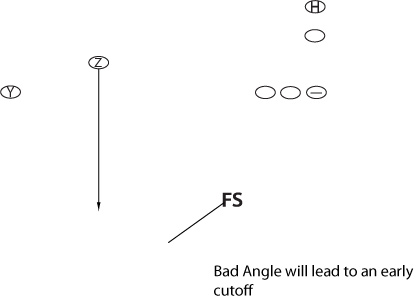
POOR ANGLE


This is the proper push angle. He should be at point with this type of leverage once the #2 WR pushes man coverage from the FS. This angle (if maintained) will allow the FS to play inside and vertical routes. A bad angle is a common mistake that many FS's make when first learning.


There might not be to much difference to the two angles at first, however the poor angle will get the FS in trouble if he gets an inside route (post or dig) from the #2 WR.

There is not as much of a problem if the # 2 WR runs a vertical route, but inside routes will be a problem. The aiming point of his angle should be past the cutoff point. The cutoff point is the point on the field where a WR will make his breaks inside or outside. It is usually at a distance 10-15 yards past the LOS. The diagram below will show the problem with redirecting from a bad angle.


This angle will make it too easy for the WR to beat the FS inside. From this point the FS will be out of phase in a chase position with no inside help. This is not middle field coverage. In this coverage inside routes must be properly leveraged to avoid giving up the big play.

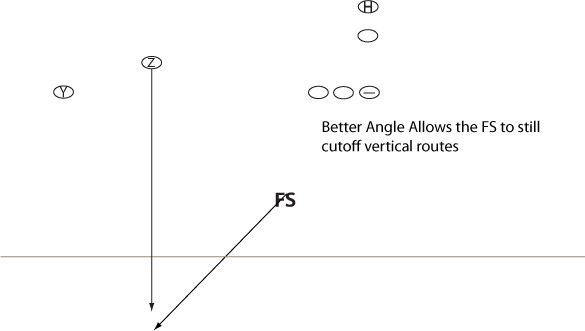
PROPER ANGLE

With the proper angle the FS will have adequate time to redirect and leverage both types of inside breaking routes.


The FS has more inside leverage on this coverage, and can see the route break-off with plenty of room to to allow for the proper recovery. This is the players main priority. It might make it harder to play corner routes, but he should have help from the corner there. This is a timeless football principal: LEVERAGE THE BALL TO WHERE YOU HAVE HELP.

This angle has benefits for the vertical route as well. If there is a speed mis-match, the FS has a better angle to cutoff the deep route.

This shows the FS cutting off the WR at the appropriate place on the field. There is still a chance the WR can cut inside but routes that deep are uncommon, the FS will have more time to recover, and the QB will probably thrown the ball the time the route gets this deep.

Below is some video of the proper angle and technique on a push. The FS is playing the TWINS WR's on the defensive left.


Even though the WR makes a break past the typical breaking point the FS should not worry too much about getting beat at this depth.

Tuesday, March 2, 2010

Pattern Reading vs Spot Dropping

This is a debate I deal with on a regular basis. What type of zone coverage is more effective for high school athletes. Most (if not all) colleges employ some form of pattern-match coverage. However, many high school coaches believe that this type of coverage is difficult for high school athletes to preform. In this post I will explore the pro's and con's of each.


Spot Dropping Defined

Spot dropping is just what it sounds like. On a pass read, pass defenders begin to drop back toward landmarks on the field. Terms like "Top of the numbers" "hash" , and "middle of the field" are used as horizontal markers. Then a depth is usually assigned. For example, a hook to curl linebacker could have a landmark 12-14 yards deep.

While on their landmark and in the process of dropping there, players have their head on a "swivel" reading the QB's eyes while they get to their landmark. In this scheme coaches emphasize two main things:

1. Break on the Ball
2. Gain depth

Pros
  • Simple to teach
  • Simple to execute
  • More eyes are on the ball
  • Better pursuit
  • Poor throws can easily be intercepted
Cons
  • Defenders can be stuck covering grass
  • There are many windows in the defense
  • Requires a better than average pass rush
  • A proficient passing team can slice you apart
  • Very susceptible to Intermediate routes.

Pattern Matching Defined


Rather than take your drop to a spot and wait for receivers to arrive, pattern-match coverage involves taking coverage to the most dangerous threat a defender recognizes in his zone. In this coverage defenders are taught to key certain receivers when they read pass. Usually, it is the #2 WR to their side. From the receivers action, they can diagnose whom the most likely threat to their zone is.

After a certain point, pattern-match coverage turns into man coverage. The aim of this coverage is to get the best of both worlds. Zone offers defenders the advantage of having their eyes in the backfield playing the run before the have to commit to the pass. On the other hand, man coverage puts defenders in the dark as far as the run goes, they are dialed in on the WR that they have in coverage. Pattern-reading uses zone principals early, and man principals late.


Pros
  • Fewer windows
  • Fewer completions
  • Ability to play run and cover intermediate routes
  • Defender aren't stuck covering grass
  • confusing for the quarterback
Cons
  • QB scrambles could hurt
  • Takes more time to teach initially
  • Fewer interceptions
  • more susceptible to the big play
  • more potential mismatches.

Are the Two Coverages Mutually Exclusive?


Is there a team that is purely a spot drop team or purely a pattern match team? I don't think so. In today's game of spread out offenses, no team will survive with traditional spot dropping. Conversely, in pattern matching the defenders know the general area that their coverage will be in.

In spot-dropping the underneath defenders are taught to see the QB as well as the WR's that could cross their zones. There are times the defenders are told to collision or re-route receivers. This is a principals at the heart of pattern matching.


My Position


These modern offense requires defenses to adjust. The same old style of defense is not gonna work the same way. As one side evolves the other side must as well. I am a firm believer in pattern reading. It just make sense in today's game.

The main argument against pattern-matching is difficulty. Many coaches argue that it is too difficult and that typical high school athletes cannot handle it. They reason along these lines. "Spot dropping is easier than pattern-matching. Our players are making mistakes spot dropping. So how can they begin to understand pattern reading?" The other line of reasoning involves the capability of high school athletes. Many critics question a players ability to see all these routes. I agree that at time it may appear like a lot, but like anything in football, it can be taught if you perfect the way you are going to teach it.

Training the Eyes

When making any type of "reads" in football, it all boils down to the eyes. There needs to be methodology to where a players eyes are supposed to be looking and how they respond to what they see. The more clear we can be with the progression of a players eyes, their ability to diagnose a situation, and trigger the appropriate response; the better we can all be at coaching defense. In the analysis below, the focus will be on underneath droppers, not the deep defenders.

Eyes in Spot Dropping


First, eyes begin on the run/pass key. The most common keys are linemen and running back. Regardless of the key, the player should be able to diagnose run/pass and then move on to the next action. If the defender reads pass, the player should open to his landmark and begin dropping. The eyes should go to the QB second to diagnose the drop type. (On sprint out flow rules usually trigger) On straight drop back plays the linebacker continues towards his landmark reading the QB back to his landmark on the "swivel". This is the basic way of spot dropping. Most coaches have tried to incorporate reads into their drops. However, this is where problems have occurred. The problem is usually a rules conflict.

This conflict stems from two primary goals of spot dropping. First, is the ability to see the QB so the defender can break on the ball. Second, is to gain depth. This is done to prevent an intermediate route from getting wide open. The philosophy is that if the player can accomplish goal #1 and goal#2 then the only open passes should be shallow routes. Shallow routes are not a big concern, because the underneath defenders will be able to see the QB release the ball. This allows the players to break forward and keep the play to a minimal gain. However it usually does not work this way.

Intermediate routes become open anyway. The defenders are so busy focusing their eyes on the landmark and QB that they don't know where the intermediate receiver is going to be. By the time they "break on the ball" they are usually out of position to make a play on it. Coaches begin adjusting their drop rules and involve pattern read concepts. They try to train their players to see these routes developing. Many times these players learn how to do this. However, the rules conflict rears its ugly head. When you begin to involve reads two things usually happen. First, the defenders do not see the QB as well and the "break on the ball" is not as good. Second, depth suffers because droppers will stop and delay more when reading routes.

This angers the traditional spot-drop coaches, because they have always emphasized breaking on the ball and gaining depth. They have the habit of emphasizing these top two goals. The main problem is there is no clear process of where a players eyes go. In traditional spot-dropping the eyes are simple: swivel from the QB to the landmark. If you begin to involve reads into this system and emphasize these two goals the same way, then conflicts will be present. Spot-dropping will become more difficult and frustrating then before. I am not saying all spot-dropping coaches go through this. I am noting this because it is a trap that is easy to fall into.

Whenever you begin integrating route-read concepts into a spot drop philosophy, players will not drop to depth as consistently nor break on the ball as quickly.


Eyes in Pattern Reading

Similarly to spot dropping, eyes begin on run/pass keys. Once reading pass, the eyes go to a completely different place than their spot-drop counter parts. The body begins dropping in a predetermined direction, but the eyes flash to a particular receiver. Depending on what that receiver does the eyes could move somewhere else and/or the direction of the drop can alter quite a bit. Players are usually given a 3/2 drop or 2/1 drop. These are forms of "Hook to Curl" and "Curl to Flat". Here is an example

A 3/2 drop is usually an inside linebacker. On pass he opens at 45* and reads #3 (usually the RB) if he releases vertical he has him man to man. This is simple, on pass look at #3 if he goes deep you run with him. If #2 blocks or releases outside, the backer expands his eyes to #2. If #2 is running vertical, the backer walls him off and gets his eyes on #1. In this step he is anticipating #1 to make an inside cut (curl or dig route). If #1 continues vertical past 15 yards his final read is the QB, his technique to break down and rob the QB's eyes. This is not an exhaustive list, just a simple example of eye progression in pattern-matching. To Recap the linebackers eyes:

3/2 Pattern-Drop Eye Progression

1. Run/Pass Key
2. #3
3. #2
4.#1
5. Rob the quarterback's eyes

This is an example of cover 3 rules. In Cover 3, it is difficult for the inside linebacker to get underneath curl routes in a spot-drop scheme. But, in pattern reading the reads take the backer to the curl, to the point that he is anticipating the route. It is easier to get coverage on the route because the backer will have his eyes on the receiver.

At first this may seem like a lot to someone unfamiliar with this type of coverage. With enough time and understanding it becomes easy to coach. The key is emphasizing the progression of the players eyes and the recognition of what to do. This only requires simple terminology and efficient drills.

In this philosophy, you don't have to talk about routes in the general sense. Terms like slant, hitch, dig, and arrow can confuse the process. You only need to talk about receivers and their movements. If a player makes a mistake on his reads, the process is simple to correct. Questions are the key. Using the example of the 3/2 drop discussed above: if a player failed to cover #1 on a curl, what was the problem. He probably never got his eyes on #1. Ask him, "what did #1 do?" He won't know. Players will gain confidence in this system, because through repetition, reading a route progression will become second nature.

One major drawback to pattern-matching is that there will be fewer interceptions. Turnovers are a big key on defense. You have to weigh it with the benefits. The increased coverage will lower receptions and scoring. As a coach you have to decide what best fits you.


Summary

As the game changes so must we. High school teams have become more effective at passing the balls. If you try to play the same old keep the ball in front of you and break on the philosophy, you are going to get exploited. Spot dropping has its merits, but when you play in a league with proficient passing teams, you are gonna have trouble. Offensive coaches have done a great job.

Pattern-matching can make a tremondous difference for your team, if you commit to installing it. High School athletes can handle it. I once worked with 8th graders in the offseason, and showed them how to read routes. After a week it became easy for them. They would play 7on7 and have the routes covered. They even would talk to eachother with the proper terminology. The 2/1 dropper would yell at the 3/2 guy and say "Why did he catch the ball? #3 released out and #2 came in at you."

If spot dropping works for you and you are having success with, then by all means commit to it. A scheme is as good as its effectiveness. As coaches it helps to understand the different things teams are trying to do. Down the road coverage will probably take another evolution, because offenses will begin adjusting to pattern matching even more at the high school level.