Friday, July 16, 2010

4-2-5 Alignments-Part II


PRO-I SETS

Alignments to the pro I is very straight forward and allows room for flexibility and imagination. In this part I will focus on base alignments with a few other options.


CALL: TITE-2

The front and secondary both declare the strength the same way in this alignment. The TITE call puts the 3-tech towards the TE, the strong DE aligns in a 6. The backers align in 30 techniques. Some people argue that the backers should align in their gaps. ie, the RB should be in a 10. However, in the 30 alignment the RB can still defend his A-gap and is in a better position to play outside and off-tackle plays towards the TE.

The secondary calls "read-left" and sets the SS and FS in coverage to the left. The strong safety aligns 5-7 yards outside the TE and about a hard from the LOS. Also, the SS cocks his stance in and places himself perpendicular to the LOS. This alignment allows him to get under routes by the #1 WR, have a good angle to force the ball, and make it difficult for the WR to crack block him. The last reason needs further explanation. Teams like to run outside, will get tired of the SS forcing the ball back inside. So, they will attempt to crack him inside in order to get around the edge.

Making the crack difficult is accomplished by this alignment for a couple reasons. First, his back is turned to the WR. The receiver cannot legally block him in the back. Second, if he does attempt to crack block him, the crack will occur near the LOS. By making a crack happen at the first level, the corner is free to replace the SS as the force man. If the crack occurred further from the LOS, the corner could not replace as quickly, because he has to respect the crack and go. By attempting the crack at the first level, the threat of the crack go is eliminated. It is difficult to fake a first level crack and turn it into an effective go route.

The WS aligns in a postion to force the edge to his side and play the cutback on plays toward the TE.

VS TWINS

CALL: TITE-25

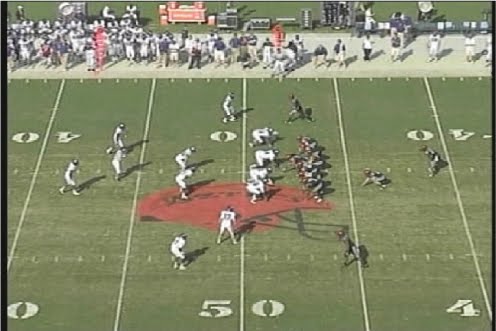
Twins is a formation where the front and secondary call the front in opposite directions. The AB is aligned in 10 in the diagram, but he could just as easily be aligned in a 30, it makes little difference. The SS and FS align to the twin WR's just like they would versus the spread. On the TE side the corner is shown close to the edge playing force. The WS could just as easily be there. The alignment each year might be different depending on the type of corners and WS you have. Below is a diagram of TCU from this past year aligning to twins.

Versus the Full-back set strong


Here the backs slide over and WS comes up into the nest, this call a "scoot" adjustment. Everything else is the same as regular pro-I alignment.

FLEXBONE


Here the alignment follows the base rules. The strength in the diagram is arbitrarily to the left. Versus the balanced front and the motion based nature of the flex-bone, the free safety will declare the read-side upon motion.


GOAL-LINE

The last view diagrams are an example of how TCU aligned versus Clemson principals. The particular scheme they employ is not really special to the 4-2-5. I am showing it as a way of understanding how the particular positions are aligned.


A safety has replaced one of the corners on the right edge. The DT's are hard A-gap player, and the backers are cheated-up into their gaps. There are two safeties to each side aligned on the edge and behind. The corner in the middle is adjuster who moves with any motion by the backs. This allows the front to stay relatively focused on the play by leaving adjustments to the corner. The next diagram shows the formation after motion.


Thursday, July 8, 2010

4-2-5 Resources

Blitzology posted links to some playbooks for people interested in the 4-2-5 defense.

Also, I have included links to two other files.

First, is a link to a 1997 article by Gary Patterson describing some of the principals and philosophy behind the 4-2-5. If you have not read it, it is a short but worthwhile article on the ideas and benifits that are behind the 4-2-5.

Second, is a link to an AFCA article by David Baliff, the current head coach at Rice University. He is the former D-line coach for TCU and Head Coach at Texas State University (formerly Southwest Texas State). He currently runs and has run a very similar scheme to Patterson's. This article details some blitz and alignment principals.

Third, is another article by Baliff where he outline some technique and schemes with d-line twists. The information on technique is excellent as well as the simplicity behind the twist game terminology, this is typical wording to anyone familiar with the 4-2-5.

Gene-Stallings- Football Philosophy

Gene Stallings was a great coach. He believed that the first step in developing a winning team began with developing a philosophy. He had very clear views of his philosophies on both offense and defense, and was insistent upon sticking to his philosophies at all cost.

OFFENSE

His stated "On offense I want to score, I want to score a touchdown, I want to kick the score, or move the ball far enough that my opponent has to go 80 yards to score." He was running the veer option one year, and lost a bowl game due to numerous offensive turnovers. In the off-season, he decided that his team needed to move away from the option. He believed that they could dedicate no more time to perfecting the mechanics of the offense, and that even the significant time they put into the previous season, was not enough to prevent these turnovers. He made this bold move because he believed that the option went against his philosophy. The schemes that a coach develops come after the development of a philosophy. Stallings calls this the "Method."


DEFENSE


Stallings impact and emphasis in football was defense. More of his time was dedicated to defense than anything. His philosophy on defense was simple: "I want to prevent my opponent from moving the ball effectively." This is pretty obvious, but he believed that not everyone ascribed to this philosophy. When it came to developing a method for his defense he believed he had to create a coordinated defense. "I want the front to coordinate with the force, and the force to coordinate with the coverage." For him, football was a game of forces, and that if he could force the ball well and defend the end run effectively, then it would make it hard for the offense to move the ball effectively.

On defending the end run, he believed that there were three key parts. These parts have become central to the development of any effective pass coverage scheme. These three parts are:

1. A player to turn the ball back inside (run force).
2. A player to play the cutback (alley)
3. A player to play the play-pass.

This is all you need to defend the end run. If each person does their job, the offense will not be able to run the ball outside. The first two parts are obvious, the third was not as much in the past. During these days the pro-I was the norm. Teams tried to establish the toss game. If the toss was getting played aggressively, then they would employ the tricky toss-pass. This play was not designed as much a "trick-play", as it was a play to keep the defense honest. The third part of defending the end run, was the player responsible for defending against these tricky plays.

He was insistent that his players understood the principals of run force as well. It was important that each of them knew their responsibility and played their part. He did not want two people forcing the ball or two people playing the play-pass. For example, if the alley player got outside with the force player, he would ask him: "Do you think that the corner can force the ball back inside?" The players would say "yes". He would then answer by asking "Then why are you trying to force the ball?"

He changed his pass coverage by changing his forces. If he was in pistol force, the corner was forcing the ball, the safety was playing the pass, and the linebacker was on the cutback. This was 1/2's coverage. He could control these forces independently on both sides. This was an early form of the split-safety coverage that is employed today. If the call was rifle force, the safety played the force, the corner was on the play pass, and the backer played the cutback. This is the same force package that modern quarters teams employ. Finally he would have box force. This was backer force. The safety played the cutback, and the corner was on the play pass. This force was used on the weak side of cover 3, and man coverage.

Stallings was also a proponent of press-man coverage. He believed that if you sat in zone, the offense would be able to move the ball effectively with short controlled passes. He would talk to coaches about getting the fear of getting beat deep out of their heads, and make a commitment to utilizing aggressive man. I am sure that most defensive coaches are still scared of press-man coverage. Stallings was probably a little uncomfortable too. However, he knew it was something he had to do in order to prevent the offense from moving the ball effectively.


BECOMING A GREAT COACH


Another part of his belief structure was on being a great coach. To be a great coach you have to be a great teacher. And to be a great teacher, you have to be able to "speak with authority". He preached the basic parts of effective teaching such as accountability and attitude. However, he stressed another, sometimes overlooked part of the job. Speaking with authority meant you were completely knowledgeable about what you were talking about. If you did not understand something fully then the players would be able to see through that.

If you are an offensive coordinator, you better know the passing concepts, blocking schemes, and the various mechanics of each position in and out. "If you don't, then you are cheating your players." The same went for defense. Also, if you were a position coach you better know that position inside and out. A great coach should know it to the extent that they are educated about it in schemes that are not part of the ones they coach.

The head coach was no different. Stallings believed that the head coach should be knowledgeable about all the aspects of football. The head coach should know offense, defense and the kicking game in depth. If not, you are cheating the team. This is crucial, if you are an offensive coach that becomes a head coach. How can you speak with authority to your defensive coordinator, about an issue you have with his scheme, if you don't know defensive football in and out? This what he believed was necessary for speaking with authority. When a coach gets up to the board to talk football, he needs to be able to speak with authority.

Finally, Stallings explained a simple process for getting to this point. He believed that a coach should dedicate one hour per day to studying football, any aspect of it. This is a time where you don't take phone calls or any other type of distraction. You can read about football, watch films, talk to others whom are knowledgeable about football, ect. If you do this consistently, after a few years "you will be an authority on any aspect of the game." This is what I love about reading football blogs, it is a time to dedicate yourself to getting better at the game.

CONCLUSION

This is just a snapshot of Gene Stallings' Philosophy. The important thing to take away from this is the commitment he made to sticking to it. He altered his offensive schemes and defensive coverage to stay consistent with what he believed. This commitment was a big part of his success. Perhaps, the biggest key to becoming a great coach was doing the things necessary to be a coach that can speak with authority about any aspect in the game of football.

This information was gathered from the 1992 and 1993 COY Manuals.

Saturday, July 3, 2010

4-2-5 Alignments-Part I

QUICK NOTE

This is part 1 of a 2-part series on alignments. The alignments I will discuss are in no means things I would do every time. Doing the same thing every time to a particular formation is a recipe for disaster. The offense will be able to scheme you, because they will be able to predict what you are doing. Also, you will be in a position where the offense will predicate to you what you will be in defensively. So when looking at these alignments, consider them a solid base alignment that can and should be adjusted to keep the offense off balance.

In this part, I will discuss alignments versus 10 personnel. Doubles and trips variations will be the focus. In part II I will cover spread sets that involve tight-ends and pro running formations.

BASIC PHILOSOPHY

The 4-2-5 Defense is very flexible to multiple formations. The fundamental thing to keep in mind when aligning to various formations is common sense. The quarters coverage concept is very self-adjusting and does not require too much movement. An important point is linebacker alignment versus 10 personnel spread formations.

The idea behind alignment and coverages in this scheme, is to create an advantage where there is one more defender to each side of the formation (+1 Rule). If there are two WR's to a side, the defense wants to put 3 people in coverage to that side. The linebackers are the people for the most part that allow for this advantage to happen.

As a rule of thumb, the linebackers should slide over to the side that is needed to create this advantage. This usually fits into two rules.

1. Versus a 2x2 formation the backers should slide towards the away-side of the coverage.
2. Versus a 3x1 formation the backers should slide towards the trips.

ALIGNMENT vs 2x2


Versus doubles in the middle of the field, the alignment is simple. If the call is 2-blue-solo. The read-side would be in cover 2 (robber) and the away side is in blue coverage. I will not go into the rules of these coverages, I have discussed this in a previous post. The linebackers slide toward the away side. In the above diagram, the read side is arbitrarily to the left, not because of the back. The read side could just as easily be set to the right. When the ball is in the middle of the field, other factors (devised by game-plan) dictate which side is the read side when the ball is in the middle of the field. A particular receiver, the quarterbacks preferred side to throw, and the opponents bench could all be factors that push one side to be the read side over the other. The time the back plays a role, is the option. If the team is able to run the option well, then the back is an important consideration. However, the offense can easily move the back to the other side and or stack the back behind the QB. This is why the back should not be a dominating factor when setting the read side.

The backers slide to the away side in order to get the mike backer closer to his coverage responsibility and maintain effective positioning on the run. Also, the FS will be involved aggressively to the read side. This allows the backers to slide toward the away side.

One problem with this coverage to the middle of the field is the soft cushion to the slot on the away side. If you sit in this look the offense will attack the away side heavily. The smash, All hitch, and other quick combinations are difficult to cover consistently from away-side blue coverage in the middle of the field. In short, the away side is susceptible to the quick game.

Fortunately, there are a couple things that alleviate this problem. First, the ball is not in the middle of the field often. Usually the ball is on a hash. With ball on the hash, these problems are not as significant.
Blue coverage is much more sound on the hash. The rule for setting the read side in this situation is the field. Versus 2x2 on the hash the FS should set the read-side to the field side. Away side blue is better on the hash for two reasons. #1 The mike is in a better position to get under both WR's, and #2 the receivers do not have as much room to maneuver.

The other thing that alleviates coverage problems when the ball is in the middle of the field, is the ability to mix in coverages to the away-side. The easiest adjustment to the away side is to get into man. Man coverage is designed to take away the quick passing game. If the offense has to guess whether or not the away side coverage is in blue or man, then they will have a harder time attacking you. They will have an even harder time if the WS and away corner do a good job stemming their looks. The backer does not need to stem coverage because his alignment is the same.


The backers do not have to change their alignments. The only thing that changes, is the the away-side backer (mike) is now responsible for forcing the ball and covering the pitch on the option. Again this is not an adjustment that you do all the time. But mixing in blue and man to away-side, when the ball is in the middle of the field, is a solid strategy for dealing with 2x2 formations.

Another important consideration versus 2x2 sets is the splits of the WR's. There are many different variations in their splits, too many to cover in this post. The important point is this: receivers usually alter their splits and alignments for particular reasons. If a slot receiver aligns closer to the core of the formation, he is usually leveraging an outside cut, conversely, if he aligns closer to the sideline, he is leveraging an inside cut. These variations must be accounted for. Here is a common example.


When the receivers get closer to one another, they are usually going to cross somehow. In this particular variation #1 has closed his split and # 2 has widened and deepened his. This is a common adjustment by the offense when the defense puts a defender in outside alignment on the slot. In robber coverage the SS aligns outside the #2 WR. However, versus this variation this would be a bad idea. The offense aligns like this to put the SS closer to the #1 WR. This allows the #1 WR to get around and inside the SS on a slant route easily. The FS will not be in a position to stop the completion. The play to expect here is a Bubble by #2 and a quick slant by #1.

The adjustment in a quarters concept is to adjust the coverage to leverage the most likely route combination. Versus this variation the read side should check into blue coverage. This moves the SS inside the slot in a position to slice the #1 WR, in this case, the slant route.
If the offense does run the bubble slant combination the coverage will be able to play it perfectly. The diagram below shows how the defense should cover these routes.

ALIGNMENT vs 3x1

Versus trips the alignment is simple. The backers should now slide toward the trips side. The base coverage adjustment to trips is to play SOLO coverage. Solo allows the read side to play cover 2 on the #1 and #2 WR The read backer and WS will be responsible for covering the #3 WR.
The backers slide to create a 4 on 3 advantage. The read-side backer is responsible for the short wall of the #3 WR. What this means is he cannot let #3 run a short crossing route. If he lets #3 get across the formation there is going to be a problem, because there is no one on that side to pick him up. The away backer and away corner are both in man coverage, and are not guaranteed to be there. The WS is responsible for covering the deep vertical and post routes by the #3 WR.

Not all trips are created equal. Offenses think too! (For the most part.) Different trips variations are common place in today's game. Some of these variations will make x-out adjustments (like special) more effective. Versus displaced trips alignment should look like this.
The read-side corner will man #1 (x-out), the SS and read-backer will banjo the in and out routes of #2 and #3. The FS will be in deep 1/2 to provide deep support. The SS, FS, and read-backer are playing blue coverage on these WR's. The away side can vary their coverage. In the above diagram I have shown man with the WS in 1/2's. You could also run a 3-way with the backers and SS.

ALIGNMENT TO EMPTY BACKFIELD

Empty backfields are not a major alignment problem either. Keeping with the idea of common sense and the +1 rule, aligning to empty is a simple process of following the rules. If a team run an empty backfield, there are only two things they can give you. 3x2 or 4x1. The same split variation principals apply here as well. Versus a 3x2, alignment should look like this.


The backers should stack behind their respective ends and read for the QB draw. Once they clear the draw they are on slice responsibility. To the read side the corner x-out's #1 so the read backer is slicing #2 and #3. This is the same technique he would be in versus any trips with an x-out adjustment being run. This is not different. To the away-side the backer plays the same technique that he would play versus a 2x2 set. To him it is still just two WR's.

If the offense runs a quads set, there is only one simple variation. Because the offense has 4 WR's to a side, a backer need to now get out of the box entirely to remain consistent with the +1 rule.

By bouncing the backer out, the defense now has a 5 on 4 advantage. The mike is now the short wall player and the WS can run his solo technique, this time reading the #4 WR. Again the #1 WR is discounted because the corner has him on an x-out.

SUMMARY

Again these are just some of the things you can do in split-safety coverage in the 4-2-5. The rules are simple and allow you to leverage the formation and plays the offense is in a position to run. In the next part I will cover TE spread formations and 2-back sets.


Wednesday, June 23, 2010

3x1 Formations- Defending the Open Side

In my original post on Split-Safety coverage I outlined a simple system in the 4-2-5 for handling trips formations. The base adjustment is solo. This coverage locks the away side into solo coverage and allows the read side to defend the trips with a variety of options. This is the preferred way to defending the trips side of the formation. However, like any coverage, if you sit in it too long the offense will eventually attack the open side. Solo coverage is most vulnerable to the single receiver side. That is where special coverage comes into play.

Special is designed to create games and options on the single WR side. In this post, I will cover some of the coverage options that can be used have to defend routes to the single WR.

BRACKET

The first and most basic coverage to the open side would be "bracket." This coverage allows the WS to be in a position to aggressively force the ball on the run and take away the quick and intermediate routes of the #1 WR on pass plays.

The corner is man to man soft over #1. His rule is DGBD...Don't get beat deep. He has #1 and he needs to be able to defend the fade, post, corner, and skinny. The WS upon reading pass needs to work into a trail position on the WR. From this position he is man to man on any inside, outside, or stopping route by the WR. The linebacker will have the back man to man.

During the release phase the WS must work into a trail position. Versus a comeback route the WS should be in the proper position to take this route away.

Also, Versus a post, the WS and corner should have the WR on a high-low with no place for the QB to put the football.


TRAIL

Trail Coverage is the reverse of bracket. The corner will align outside and deny any outside releases by the WR. After the initial release the corner will work in a trail position, and is responsible for any quick, intermediate inside/outside cut bt the WR. The WS is soft man over #1 with DGBD responsibility.

This is a great change up and can easily be mistaken for solo coverage. This will be confusing to quarterbacks. Trail coverage on the dig route looks like this.

1/2's

The final option I will discuss will be simple 1/2's coverage. 1/2's coverages is a great change up on the open side. It changes up the run force to that side, allows the corner to sit and have interception chances, and keeps the backer from having to run with the running back to the flat. The only situation where the the backer would have the back man to man is on a deep release. I am not going to go into too much detail here, there is plenty of discussion and videos on playing halves coverage. Brophy especially has some good resources on running this coverage versus, multiple sets.

Friday, June 4, 2010

Defending Tight Bunch Formations

Bunch formations cause problems for defenses that are not prepared for them. When receivers reduce their splits in respect to one another it usually means that some time of pick or exchange route is about to occur. The split reduction is problematic for the defense for multiple reasons. First, you can't run press-man on both WR's. Alignment won't allow you to. Also, to run straight man against reduced splits is suicide. The offense will pick you off and open-up a WR to the inside or outside. Because of this threat, defenses have to stay in pure-zone or combo-man coverage.

The blitzology blog had a recent post to deal with these types of sets. The coverage techniques that are explained are excellent and identical to what I would do versus those particular sets. Especially the coverage that is explained about wide bunch. In 4-2-5 terminology we call this coverage "TRIO" and man the SS on the #2 WR and play blue coverage on the #1 and #3 WR's with the corner and free-safety.

However, versus tight-bunch formations this coverage adjustment is not as sound. The tight-bunch formation is displayed below:


This formation can be used to attack you with the pass just as easily as the run. The formation is very similar to a formation with a TE and two wing backs to the same side. So the first priority to defending this set is to align the defense in a way that prevents it from letting the ball get to outside. If you play normal "trio" coverage versus tight-bunch formations, you are not going to have a player in a position to force the ball inside. This concept is paramount versus this formation, because it is so easy for the offense to wall-off the interior players.

3-WAY COVERAGE

The adjustment of choice is "3-way". (This is a different use of the term 3-way then what I discussed in a previous post in respect to what Buddy Ryan called 3-way ). 3-way coverage seeks to allow for combo man principals to be in place, while at the same time establishing a force player to leverage the ball back inside. 3-way alignment looks like this.


This alignment puts the defense in a good position to play the run or the pass.

VERSUS THE RUN

Versus the run 3-way places the SS in a position to force the ball inside. The corner is assigned play-pass responsibility, and the FS is a flat-foot read player that plays the alley aggressively. The backer is cheated over to help on the outside running plays. The end also solidifies the integrity of the defense by forcing one of the bunch WR's to block him on an outside run. The defense has 4 immediate players to defend the run against the 3 WR's the offense has to block. The offense has to leave one player unblocked on any outside running play. (The other posibilities are option (not a big problem, because the SS is in position to play the pitch) and the chance that the OT can scoop the backer. If this happens coverage adjustments are the least of your worries.)

If the Z WR blocks out on the SS, then the offense is in a lose-lose situation. They have to decide which player they want to team-off on. Either the FS or backer is going to be cut loose.

VERSUS THE PASS


Against the pass the rules are easy. SS has the first man to the flat, if no attacks it, he sinks under the first WR outside. The Corner has the first deep route outside, he is going to pedal on the pass and read the WR's. The FS has the first man deep inside, his technique is essentially the same as the corners. If a deep receiver does not show in or out, then they play a "zone it" technique and help their partner. The diagrams that follow are examples of how the coverage will work versus various route combinations.


3-way coverages is simple to execute because it works off other coverage principals that are part of the 4-2-5 Defense. Other defenses can integrate this coverage into their schemes. The number one concern with implementing this coverage, is the ability of the force player (SS). This player needs to be strong enough to force the ball inside and agileenough to run with a wheel route.

Monday, May 31, 2010

Defensive Fundamentals: Training the Eyes

In my post about "Pattern Reading vs Spot Dropping" I briefly talked about the importance of training a defenders eyes.


When making any type of "reads" in football, it all boils down to the eyes. There needs to be methodology to where a players eyes are supposed to be looking and how they respond to what they see. The more clear we can be with the progression of a players eyes, their ability to diagnose a situation, and trigger the appropriate response; the better we can all be at coaching defense.
Determining a progression for the eyes to follow coupled with a set of movements (responses) is the key to effective defensive football. All positions on defense can involve this principal. In this post, I will look at different positions and describe possible eye movements and progressions.

Why the Eyes?

The #1 mistake on defense is a player having his eyes in the wrong place. No matter how well a player is taught to shed blocks, break and intercept passes, or form tackle, it can all be for nothing if the players eyes are in the wrong place. The various techniques we teach to our players are intended to be used during a particular situation. Few techniques (like back pedal steps) are used on every play. The majority of these techniques are situational. What good is squeezing a down block on a pass play? Or dropping to the flat on a run play? Neither of these techniques would be good because they are inappropriate for the situation.

What tells a player the appropriate technique for a particular situation? Some type of visual cue. Players execute their techniques more effectively when they begin to make the connection of a visual cue with the desired technique to execute at a faster rate. The single most important point to training the eyes, is it will allow a player to execute their various techniques in the appropriate situations at a fast rate. This type of mental/physical conditioning process is what allows players to play fast, and the key to consistent execution come game time.

In this post, I will look at 3 different positions and describe possible eye movements and progressions.

1. Middle Field Coverage-Free Safety

Run: Alley Player Inside Out
Pass: Middle 1/3

I have discussed part of this technique already, but I will begin here with initial pre-snap eye keys. Player should align in the middle of the field and then get his eyes on the center or most visible offensive linemen. At the snap the FS should get into a backpedal and read the center for run/pass.

Eyes on Run Plays : If the linemen attacks aggressively forward, the safety should immediately get his eyes in the backfield to diagnose the direction of the run flow. Upon identifying the flow, he should Plant, point, and drive towards the ball carrier on an inside out path. On his pursuit he should keep his eyes on the ball carriers inside hip and maintain vision on a path that has the ball carrier inside and in front of him.

Eyes on Pass Plays: When the linemen key works backward (indicating a pass) The FS should maintain his backpedal and immediately get his eyes on the QB's non-throwing arm. He is looking for the long-arm of the QB. Upon Reading the long-arm the FS must intercept the pass with his eyes. This means he needs to locate the place on the field he needs to break to in order to make a play at the pass. Upon locating this position he should take a straight line to this spot. While in pursuit he should swivel his eye's from his aiming point back to the ball.

---- This is a simple progression of eyes that will keep the Safety in proper position. Must busts that the free safety makes will be one of two things. A. The player did not have his eyes on the proper place. B. A misread will prevent the player from executing the proper technique.

2. Press-Man-- Corner

After aligning properly inside, the corner will put his eyes on the inside hip of the WR. The corner is a dedicate pass player and will only play the run if #1 he FEELS the WR trying to block him (a good WR will run him off, so I don't plan for this too often) or he hears his FS or coach yell "Run, Run." Baring those non visual exceptions the corner will have eyes on the inside hip initially. He has 4 different techniques to execute in man coverage.

- Release
-Jam
-In-phase
-Out-of-Phase

The release phase begins with initial steps by the WR. During this phase the corner will use slide steps to move vertically and replace steps to move laterally. These steps are used to keep in the proper inside relationship with the WR. The corner is keying the hip because it is a true read for him. The WR's feet, chest, and head are all more misleading than the inside hip. What he is looking for from the hip, is for it to commit. When the hip commits the corner is now in the jam phase. When the hip commits it turns and breaks a 45 Degree barrier. Upon reading a commitment of the hip, the corner gets his eyes on the near number (pec) of the WR and jams it with his off hand while opening his hips. The opening of the hips and off-hand jam are designed to keep the corner on top of the WR.

For example, we will assume the WR releases outside. Once the initial jam is done, the corner must assess his position on the WR. Can he see the near number of the WR or not? If he can, he is in-phase, and his eyes will focus on the WR's eyes with his peripheral vision on the V of the WR's neck. If the WR's eyes turn to look for the ball, the corner turns to play the ball as well. If his eyes and V of the neck turn back, then the ball is under-thrown. The corner needs to basketball block the WR from coming to the ball while making a play on it himself.

If the corner cannot see the near number after the jam phase, then he is out of phase. His eyes will not leave the WR until the whistle. He will key the WR hands. If the hand move to catch the ball, then the corner will wait for a "1000-1" count then rake the WR's hands.

----------- Mistakes like opening the hips the wrong way, wrong hand on the jam, getting beat off the line, and allowing an easy catch are all problems that start with the eyes. Corners get beat inside on slants when their eyes migrate up to the WR's chest. Many catches are made when a corner is out-of phase with a WR and then peeks back to find the ball. These techniques are not very effective if the eyes are undisciplined.

3. Defensive end in a loose 5 technique

C-Gap Player
Technique: Squeeze on down-blocks, does not get reached, Spills the ball on pulling plays, Outside contain on pass.

After he aligns outside the offensive tackle the end will key the feet of the offensive linemen. He is trying to identify which foot the linemen will step with.

If the linemen steps with his inside foot, he is trying to down or scoop block another defender. Upon reading this the d-end should step laterally with his inside foot and squeeze the down-block. While squeezing down the line his eyes should peak down the line for any pulling lineman. If a pull is coming he must attack the inside shoulder of the linemen with his outside arm. If he does not see a puller, he gets his eyes on the backfield, he will take the running back on any read option.

If the linemen steps with his outside foot the end will step with his outside foot. He continue to read the feet for the second step. Is the lineman's feet working backward, toward, or around you. These cues will alert the end to what type of block he is facing. If the feet are working backward it is a pass block, this tells the end to get up-field and rush the passer. If the feet work toward him, he is getting a drive block, he must stay low and hold his ground. Now his eyes flash to the backfield to locate the ball carrier. He will remain in his C-Gap until the ball commits away from it. Finally, if the feet are working to get around him, he is facing a reach block. He must work his hips around the blocker and hold his gap integrity.

--------------Again eyes here are crucial. Defensive ends who run up-field on down-blocks are a major problem for 4 man fronts. This problem opens up huge running lanes for counters and options. This problem is a lack of focus with the eyes. When I see this on film, the d-end usually has his eyes on the backfield and can't see the down-block. Another error is a slow-pass rush. This is a problem that coaches who over-emphasize the need to attack the linemen. Some ends will be so focused on attacking the linemen that they take to long to recognize that it is a pass play. By the time he knows it the QB has had time to settle in the pocket and begin his throwing motion.

Conclusion

These are just 3 quick examples. Every position and technique in defensive football begins with reads. The key to good reads are the eyes. If you focus on the eyes of your players you will see a dramatic improvement. The eyes are the link that we have from reads to techniques. The better we are at coaching this process and emphasizing it to our players, the better our team's overall performances will be.