Showing posts with label Quarters. Show all posts

Friday, January 6, 2012

Exploiting Situations: West Virginia vs Clemson


Dana Holgorsen has earned a reputation for himself by fielding offenses that light up the scoreboard and put up monster stats. He doesn't do this by playing small ball; picking up a few yards here and there. He does it by creating explosive plays. Big plays happen when the offense exploits a weakness in the defense or a defender or two blow their assignment. In the first quarter of the Orange Bowl, the West Virginia offense completed a 34 yard pass to a wide open receiver. This play is an example of how the offense can create explosive plays by exploiting a weakness in the defense.

The play that will be analyzed can be seen here:


This play was created by exploiting 4 primary factors:

1. Situation (Down and Distance)
2. Ball Position
3. Formation
4. Personnel

The first factor is probably the biggest one on a football game meta-level. The final 3 can be chunked together into one thing.

EXPLOITING THE SITUATION

In a previous post I covered down and distance strategy. The goal for the defense is to get the offense into a manageable 3rd down situation (3rd and 7 +). The way to do that is to limit gains on first down to 3 yards or less. This is why the running game is so important to the offense because it can keep the offense out of difficult third down situations.

This play occurred on first down. It is in Clemson's best interest to keep the West Virginia offense from gaining more than 3 yards. In order to do that they can't be overly worry about the big play. This does not mean you allow the big play, but that you get defensive calls in that are more aggressive towards the run. Because of this principal, Clemson would most likely be run conscious in this particular situation. "Run Conscious" meaning probably in a base front with zone coverage.

BALL POSITION, FORMATION, PERSONNEL

These next three factors work together.


Ball Position

The ball is on the hash, it is on or around the hash approximately 80% of the time. Modern defenses are even more concerned with ball position because opposing offense have become more creative in utilizing it. The hash is such a concern that many defenses will call coverage strength to the field the majority of the time. One of the few things that will keep a defense from calling its passing strength to the field is trips formations.

Formation

This brings us to our next factor. Holgorsen uses a trips formation on this play. Defending trips involves a varied plan of attack in and of itself. When you combine the formation with the ball position a very particular set of circumstances need to be considered. First, the trips are into the boundary. This is not a common occurrence for the defense. Most defensive trips schemes are built on the premise that the offense is running trips towards the field. Boundary trips is in the back of the defensive coordinators mind, but does not call for concern like field trips does.

How does boundary trips effect the defensive thought process? First there is one WR with a ton of field to work with. This makes you think twice about putting a corner one on one with him. Second there is more space to work with for outside running plays, option or stretch being the most probable in this situation. Third, the constricted area that the 3 WR's have makes many trips side passing plays not likely. Finally, the offense can still out-flank the defense albeit with less space. This is still a cause for concern, because if not properly aligned, the defense can be hit for a 5-10 yard running or passing play easily despite the lack of space.

Because of this the defense still needs to align properly to avoid getting out-flanked while being concerned (even more so) with weak-side (field side) runs or passes.

The defense has the classic trips problem, but magnified to the open side. Which side has priority? The trips or open side? One of the things some defenses factor in is the alignment of the back. However, in this particular formation this is no help, because he is aligned directly behind the QB.

Personnel

Finally the personnel is a cause for concern. In this particular play one player is the main concern. The single side WR Stedman Bailey #3 does not have the most catches on the team, however, he leads the team in yards per reception, yards receiving, and touchdown catches. It doesn't take a rocket scientist to figure out that he is doing it on big plays. Bailey's alignment is a concern as well. He is in a position to run a quick out, comeback, fade, or anything else. His alignment opens up a large range of potential routes.

Putting it Together

Factoring all things together it is probably in the defense's best interest to free the field side safety up and have him help on the run and with coverage on Bailey. Calls like Solo or Mable would not be ideal for this situation.

THE PLAY

Clemson's Defense

They opted for a basic 4-2 front alignment and the backers are not overly cheated one way or the other. This is considered typical for this formation. The secondary is showing a two shell, which could mean anything. This could be a disguise for any number of things. The alignment that stands out is the boundary side corner. He is aligned outside the #1 WR 7 yards deep. He is not likely to come down into a 1/2's concept. Plus if the corner was playing a 1/2 concept he would need the field side safety to cover #3 vertical or a backer( vs this play that would not have been a good idea either). He appears to be getting ready to bail out.

They end up playing some type of 1/4's concept to the trips side with a 1/2's concept to the open side (could be a bracket).

WEST VIRGINIA'S PLAY

It appears that the QB might have been (don't know for sure) looking towards Bailey 1st on some type of Air-Raid "Choice" concept.


Upon seeing the double coverage, the QB would work his progression back to the trips side. This is where Dana Holgerson's play call most clearly exploits the situation. If he gets Bailey one on one, then great, throw him the ball (he actually still gets behind the double team). If they double cover him, then he has a play that will exploit the likely coverages that a defense would run on first down.


If you look at the routes, this play type can be effective versus most first down defensive calls. It really hurts Clemson's quarters concept.


The H vertical route draws the Strong Safety's attention. He cannot play the post route by the Z because the H would be wide open. The corner cannot get into coverage of the H or Z because of his outside alignment. The only thing the defense could have called to be solid versus these routes is a 1/4's bails (pure zone). That is not a sound call on first down.

This play makes the corner irrelevant and forces the SS to make a decision. He chooses to cover to the H (wise choice) and allows the z to come open on the post.

The defensive coordinator had to recognize the possibility of these play types, so he must of had a plan for them. Many defense's use backers to play wall technique on the first route to work towards the middle of the field, this forces QB's to throw high balls that give DB's time to break on it.

So where were the backers?

Its was a first down situation, and the offense showed run first. The play action kept the backers from assisting in coverage. You can't blame the backers either. Its first down, Division I linebackers are taught to play run first especially in a 1st and 10 situation.

The play action draws the backers up and because of the coverage called the Z is able to get wide open. What other zone coverages could cover these routes effectively and keep the defense from covering Bailey 1 on 1? Besides pure zone quarters, none really without linebacker help

I am not gonna draw them all up, but think about it.

1/2's: Who is gonna cover the post? There is 3 vertical routes to stress the safeties.

Cover 3: The H is gonna open on the seam with no-one to jam him, unless you play a mable tech and drop the SS down. I already discussed that this is a bad idea considering the other things the offense could do in this situation.

Special: Same problems that Clemson had, the SS is in a tough situation.

CONCLUSION

This play shows how the defense can be manipulated on 1st down. Given the situation, formation, ball position, and personnel the defense will be influenced to do certain things. If the offense understands what the defense will do, then they will be able to create big play opportunity. This shows why Holgorsen has been successful


Thursday, October 6, 2011

DEFENDING TRIPS- DISGUISE AND SCHEME


In this post I will focus on defending the trips side of a 3x1 formation. There are certain considerations that need to be made when planning out a strategy for dealing with trips. Here is the good news, usually, defending 3x1 is much easier than defending 2x2 formations. The defenses that have trouble with 3x1 formations are usually defenses that prefer to play the game with balanced fronts/coverages (hence the discomfort with the overload that trips create) or don't understand that defending trips like anything else is a risk reward game. The defense cannot stop everything, every play. The goal is to have the defense in the best position to defend the most likely range of plays the offense can run in a particular situation. Lets look at some different options you can run towards trips.

1. A Cover 3 concept.
2. An X-out concept like Special
3. A Pattern-match coverage with a safety poaching #3 (solo)
4. The Classic: Straight up Man or Man-Free

Using these 4 options we can up with a plan for handling trips in a general strategy. I am not gonna get to much into the technique or scheme of each of these, the links provided offer that. The first thing to consider is disguise.

DISGUISE

Disguising coverage in football is done in 2 primary ways.

1. Stemming and Moving around constantly every play to the extent that the offense does not know what you are in pre-snap

2. Show the same look every-time and then stem to your coverage right before the snap.

Either approach can work, but I will discuss the 2nd because it will easier to explain, and in my opinion is easier to execute.

I like running 2-Solo, so I prefer to base my trips look out of that.

From this look you can stem and work into the other looks without much difficulty.

Lets look at the others.


Looking at these alignments it should be evident that there is not too much movement involved in the stemming of each.


Again these are simple examples, but even in their simplicity they can be difficult for the typical High School QB to read. The other disguise principal involves the movement of the SS. Since it is harder for the SS to align himself out of position, he can be the defenses most liberal person stemming. He can move around, show blitz, man, ect.

WHEN TO CALL WHAT

This comes down to game-planning. The generic rule is to understand the strengths and weaknesses of each coverage. Here is a simple list. It is not complete nor detailed, but sufficient to illustrate the point.


Ideally, the defense wants to be in a coverage that best defends what the offense is trying to do. If the defense expects run toward the trips, then 3-Mable or 2-Solo are best. If the defense is worried about middle and quick game, then cover 1 is the best bet. Finally, if the single WR is a concern, then special bracket is optimal.

No matter what trips coverages the defense has in its package, they need to be coordinated and planned. The best way to protect each one is to mix them up and have a sound disguise for them. This post was a simplistic look at disguising and calling different coverages to trips. If anyone has any questions about anything let me know in the comment section.

Friday, September 3, 2010

Play Action Passes-Defending the Bootleg

I apologize for the return to the 60's hand drawn diagrams. Football season makes it hard to find enough time to write a post much less design the diagrams for it. I hope that the drawing do the job of illustrating my point.

Power running and pro-style offenses use play action passes to keep the defense off balance. One of the most difficult types of play-action passes to defend, is the bootleg. The bootleg puts pressure on the defense because it begins as a play that shows run action in one direction and then develops into a passing play attacking the defense the other direction. The bulk of the pressure comes from the offense forcing the defense to pursue one way and then have to quickly change direction and locate passing threats while simultaneously containing the quarterback. In this post I will explore defending the bootleg. First, I will explain the idea and concept of the bootleg. Then I will give a few examples of how to defend it out of cover 3 and quarters.

UNDERSTANDING THE BOOTLEG

To understand the bootleg, you must first understand the major reason that running teams use it.


#1 It punishes over-aggressive run play

The bootleg is an often used play, but derives it power the same way an infrequent trick play does. What are trick plays used for? For the most part it is not intended to "trick" the defense as much as it is designed to keep the D honest. For example, if the offenses is a big toss sweep team, they should have a toss pass in their game plan. This is important because it is needed to keep the corner and or safety from playing the toss too aggressively. If a toss team begins to notice that the corners and/or safety are playing the toss too aggressively, then they should run the toss pass. This is smart for two reason: First, it takes advantage of the opportunity to make a big time play. Second, it will take away the aggressiveness of the corner and/or safety, even if the ball falls incomplete. In effect the toss pass is the playbook to keep the defense honest. If the defense chooses to play the run over aggressively, then they will be punished by the bootleg pass.

#2 It utilizes 5 threats to attack the defense

The bootleg applies just like the toss pass, however defending it is more complicated then the toss pass. The toss pass involves one major threat and requires one player to defend it. On the other hand, the bootleg offers up to 6 threats. The more threats a play has, the more difficult it is to defend. This is the feature that makes the bootleg a great play. The majority of play action passes usually involve 4 threats. The bootleg usually has at least 5.


There are 5 Threats

1. Flat Route
2. Intermediate Route
3. Deep Route
4. Back Side Stretch route (post or dig)
5. Quarterback Run

* There is the 6th threat of the RB throwback, but I will not explore that option here, I classify that play as a trick play that punishes a defenses backside defenders for over pursuing.

The fifth threat is what separates the boot from other play-action passes. In normal play-action passes the QB sets up to read the defense, but in the bootleg he is rolling out away from flow and becomes a downhill running threat. If you are able to cover all the routes, you still have the threat of the quarterback run.

#3 It is simple to execute and change up

The boot is also easy for the offense to change up. They can run the same concept with the same reads, but be able to change up the routes. For example, they can run the boot strong and get the same look.


Not much has changed other then direction and the fact that TE runs a settle route. This route is still the intermediate read for the offense. The other 4 routes are present. The boot can be run from almost any formation as well.


Here the boot is happening out of double tight 1-back. Even though the TE (Y) and Z WR are running different routes (a push and post-corner), they are still attacking the flat and deep.


The boot can be extremely dangerous from overloaded formations like this. These sets force the defense to adjust on alignment and still maintain the ability to cover all 5 threats of the bootleg.

DEFENDING THE BOOTLEG

The first step in developing a sound defense for the bootleg is to develop rules and recognition points for bootleg strong and bootleg weak. These rules vary depending on the coverage called.

Cover 3 (Middle of the Field Coverage)

Rules for bootleg weak:

Play Side:

Flat defender----Gain Depth and break on the flat route
Corner-- Cover the deep route #3
Hook Defender---- Find and cover the drag#2
Free Safety------ Protect the middle field and eliminate the post#4

Back Side:

Flat Defender------ Check RB for throwback pass & get under the backside WR if he runs a dig#4
Corner---- Squeeze the Post to the FS #4
Hook Defender---- Become secondary contain on the QB. #5


The play side flat defender needs to gain depth and maintain leverage with the fullback attacking the flat. This is intended to allow the flat defender to help out on the intermediate route and be in a position to keep the flat route to a minimal gain. By gaining depth the flat defender give the QB the immediate read to throw the flat route. At times the hook defender can be sucked up on the run and have trouble getting to the drag.

Defending the strong side boot is very similar to the weak side boot.

Rules for Strong Side Boot


Play Side:

Flat defender----Gain Depth and break up on flat route #1
Corner-- Cover the deep route #3
Hook Defender---- Find and cover the settle route #2
Free Safety------ Protect the middle field and eliminate the post#4

Back Side:

Flat Defender------ Check RB for throwback pass
& get under the backside WR if he runs a dig#4
Corner---- Squeeze the Post to the FS #4
Hook Defender---- Become secondary contain on the QB. #5


The difficulty with the strong side boot is the settle route. The SS is put in a bind. If he is used to help on the settle route, the full back will be open and in a position to gain a good amount because of the SS leverage. On the other hand if he jumps the flat route, the hook defender will have a difficult time jumping the settle route. The strong side boot operates similar to the "stick" concept. It is covered more effectively if the hook defender is aware of the route and sprints to it as soon as he reads strong side boot.

Quarters Coverage (Robber coverage to the passing strength)

Rules for bootleg weak:

Play Side:

Flat defender----Pick up flat route #1
Corner-- Cover the deep route #3
Hook Defender---- Find and get under the drag#2
Free Safety------ Jump on top of the drag #2

Back Side:

Flat Defender------ Check RB for throwback pass
& get under the backside WR if he runs a dig#4
Corner---- Stay inside the post #4
Hook Defender---- Become secondary contain on the QB. #5


There is a trade off in this coverage versus Cover 3. Robber coverage allows the FS to play the intermidiate route aggressively, this is really the route the offense is looking to pick up a good chunk of yardage and/or first down with. By playing the FS on the intermidiate route, you can provide stronger coverage on the main two options that the QB wants to throw without relying on a linebacker that is caught in a run/pass conflict. However, the drawback is that the backside corner has to defend the post alone...... this is the most difficult route for the corner to defend. The one point of relief is that even if the post does come open, it is the last WR that the QB checks and the hardest throw to complete.

Rules for bootleg strong:

Play Side:

Flat defender----Pick up flat route #1
Corner-- Cover the deep route #3
Hook Defender---- Find and get under the Settle#2
Free Safety------ Jump on top of the Settle #2

Back Side:

Flat Defender------ Check RB for throwback pass
& get under the backside WR if he runs a dig#4
Corner---- Stay inside the post #4
Hook Defender---- Become secondary contain on the QB. #5


Again the same trade off as before. Quarters coverage allows the free safety to play the intermediate route aggressively at the expense of putting the corner 1 on 1 with the post.

Final Point

In my opinion, and you can take it for what its worth. I am more concerned with covering receivers than reading the QB on play action passes. Upon recognizing bootleg, I believe it is more important for the defenders to find and cover the threats they are assigned to cover, than dropping while reading the QB. Bootlegs are executed by finding windows, it doesn't matter if the window is behind(vertical) or beside(Horizontal) defenders. By finding and getting to the threats, the defenders will do a better job of eliminating horizontal and vertical windows.

SUMMARY

The key to stopping the bootleg is quick recognition, and clearly defined rules. Rules allow the players to know which receivers to pick up, and keep completions to a minimum. Even if they do get sucked up on the play fake, they will know which receiver they are looking for as soon as soon as they recognize pass. Any play-action pass puts pressure on the defense. Teams will use it constantly to punish defenses that are over-aggressive on the run.

Saturday, July 3, 2010

4-2-5 Alignments-Part I

QUICK NOTE

This is part 1 of a 2-part series on alignments. The alignments I will discuss are in no means things I would do every time. Doing the same thing every time to a particular formation is a recipe for disaster. The offense will be able to scheme you, because they will be able to predict what you are doing. Also, you will be in a position where the offense will predicate to you what you will be in defensively. So when looking at these alignments, consider them a solid base alignment that can and should be adjusted to keep the offense off balance.

In this part, I will discuss alignments versus 10 personnel. Doubles and trips variations will be the focus. In part II I will cover spread sets that involve tight-ends and pro running formations.

BASIC PHILOSOPHY

The 4-2-5 Defense is very flexible to multiple formations. The fundamental thing to keep in mind when aligning to various formations is common sense. The quarters coverage concept is very self-adjusting and does not require too much movement. An important point is linebacker alignment versus 10 personnel spread formations.

The idea behind alignment and coverages in this scheme, is to create an advantage where there is one more defender to each side of the formation (+1 Rule). If there are two WR's to a side, the defense wants to put 3 people in coverage to that side. The linebackers are the people for the most part that allow for this advantage to happen.

As a rule of thumb, the linebackers should slide over to the side that is needed to create this advantage. This usually fits into two rules.

1. Versus a 2x2 formation the backers should slide towards the away-side of the coverage.
2. Versus a 3x1 formation the backers should slide towards the trips.

ALIGNMENT vs 2x2


Versus doubles in the middle of the field, the alignment is simple. If the call is 2-blue-solo. The read-side would be in cover 2 (robber) and the away side is in blue coverage. I will not go into the rules of these coverages, I have discussed this in a previous post. The linebackers slide toward the away side. In the above diagram, the read side is arbitrarily to the left, not because of the back. The read side could just as easily be set to the right. When the ball is in the middle of the field, other factors (devised by game-plan) dictate which side is the read side when the ball is in the middle of the field. A particular receiver, the quarterbacks preferred side to throw, and the opponents bench could all be factors that push one side to be the read side over the other. The time the back plays a role, is the option. If the team is able to run the option well, then the back is an important consideration. However, the offense can easily move the back to the other side and or stack the back behind the QB. This is why the back should not be a dominating factor when setting the read side.

The backers slide to the away side in order to get the mike backer closer to his coverage responsibility and maintain effective positioning on the run. Also, the FS will be involved aggressively to the read side. This allows the backers to slide toward the away side.

One problem with this coverage to the middle of the field is the soft cushion to the slot on the away side. If you sit in this look the offense will attack the away side heavily. The smash, All hitch, and other quick combinations are difficult to cover consistently from away-side blue coverage in the middle of the field. In short, the away side is susceptible to the quick game.

Fortunately, there are a couple things that alleviate this problem. First, the ball is not in the middle of the field often. Usually the ball is on a hash. With ball on the hash, these problems are not as significant.
Blue coverage is much more sound on the hash. The rule for setting the read side in this situation is the field. Versus 2x2 on the hash the FS should set the read-side to the field side. Away side blue is better on the hash for two reasons. #1 The mike is in a better position to get under both WR's, and #2 the receivers do not have as much room to maneuver.

The other thing that alleviates coverage problems when the ball is in the middle of the field, is the ability to mix in coverages to the away-side. The easiest adjustment to the away side is to get into man. Man coverage is designed to take away the quick passing game. If the offense has to guess whether or not the away side coverage is in blue or man, then they will have a harder time attacking you. They will have an even harder time if the WS and away corner do a good job stemming their looks. The backer does not need to stem coverage because his alignment is the same.


The backers do not have to change their alignments. The only thing that changes, is the the away-side backer (mike) is now responsible for forcing the ball and covering the pitch on the option. Again this is not an adjustment that you do all the time. But mixing in blue and man to away-side, when the ball is in the middle of the field, is a solid strategy for dealing with 2x2 formations.

Another important consideration versus 2x2 sets is the splits of the WR's. There are many different variations in their splits, too many to cover in this post. The important point is this: receivers usually alter their splits and alignments for particular reasons. If a slot receiver aligns closer to the core of the formation, he is usually leveraging an outside cut, conversely, if he aligns closer to the sideline, he is leveraging an inside cut. These variations must be accounted for. Here is a common example.


When the receivers get closer to one another, they are usually going to cross somehow. In this particular variation #1 has closed his split and # 2 has widened and deepened his. This is a common adjustment by the offense when the defense puts a defender in outside alignment on the slot. In robber coverage the SS aligns outside the #2 WR. However, versus this variation this would be a bad idea. The offense aligns like this to put the SS closer to the #1 WR. This allows the #1 WR to get around and inside the SS on a slant route easily. The FS will not be in a position to stop the completion. The play to expect here is a Bubble by #2 and a quick slant by #1.

The adjustment in a quarters concept is to adjust the coverage to leverage the most likely route combination. Versus this variation the read side should check into blue coverage. This moves the SS inside the slot in a position to slice the #1 WR, in this case, the slant route.
If the offense does run the bubble slant combination the coverage will be able to play it perfectly. The diagram below shows how the defense should cover these routes.

ALIGNMENT vs 3x1

Versus trips the alignment is simple. The backers should now slide toward the trips side. The base coverage adjustment to trips is to play SOLO coverage. Solo allows the read side to play cover 2 on the #1 and #2 WR The read backer and WS will be responsible for covering the #3 WR.
The backers slide to create a 4 on 3 advantage. The read-side backer is responsible for the short wall of the #3 WR. What this means is he cannot let #3 run a short crossing route. If he lets #3 get across the formation there is going to be a problem, because there is no one on that side to pick him up. The away backer and away corner are both in man coverage, and are not guaranteed to be there. The WS is responsible for covering the deep vertical and post routes by the #3 WR.

Not all trips are created equal. Offenses think too! (For the most part.) Different trips variations are common place in today's game. Some of these variations will make x-out adjustments (like special) more effective. Versus displaced trips alignment should look like this.
The read-side corner will man #1 (x-out), the SS and read-backer will banjo the in and out routes of #2 and #3. The FS will be in deep 1/2 to provide deep support. The SS, FS, and read-backer are playing blue coverage on these WR's. The away side can vary their coverage. In the above diagram I have shown man with the WS in 1/2's. You could also run a 3-way with the backers and SS.

ALIGNMENT TO EMPTY BACKFIELD

Empty backfields are not a major alignment problem either. Keeping with the idea of common sense and the +1 rule, aligning to empty is a simple process of following the rules. If a team run an empty backfield, there are only two things they can give you. 3x2 or 4x1. The same split variation principals apply here as well. Versus a 3x2, alignment should look like this.


The backers should stack behind their respective ends and read for the QB draw. Once they clear the draw they are on slice responsibility. To the read side the corner x-out's #1 so the read backer is slicing #2 and #3. This is the same technique he would be in versus any trips with an x-out adjustment being run. This is not different. To the away-side the backer plays the same technique that he would play versus a 2x2 set. To him it is still just two WR's.

If the offense runs a quads set, there is only one simple variation. Because the offense has 4 WR's to a side, a backer need to now get out of the box entirely to remain consistent with the +1 rule.

By bouncing the backer out, the defense now has a 5 on 4 advantage. The mike is now the short wall player and the WS can run his solo technique, this time reading the #4 WR. Again the #1 WR is discounted because the corner has him on an x-out.

SUMMARY

Again these are just some of the things you can do in split-safety coverage in the 4-2-5. The rules are simple and allow you to leverage the formation and plays the offense is in a position to run. In the next part I will cover TE spread formations and 2-back sets.


Thursday, April 29, 2010

Quarter Coverage- Safety Push Technique

A push is when the #2 receiver to a side pushes vertical and draws man to man coverage by the deep safety to his side. In my previous post on split safety coverage I briefly explained the rules of 2-Robber and Cover 4. In both coverages vertical releases by the #2 WR past 8 yards would put the FS (and WS) in Man to man coverage on the WR. A WR vertical release past 8 yards is known as a "push" call by the free safety.


Knowing the assignments and responsiblities of a coverage is important. However, knowing the technique to execute those assignments is even more important. The technique involved in a push by #2 is more detailed than many might think. There are many misconceptions of the technique. Also, there are many ways that people teach their safeties in a push situation.

FUNDAMENTALS

The goals of the FS coverage technique on a push by #2 has two primary goals:

1. Be in position to cutoff deep vertical routes.
2. Have good enough leverage to play inside cuts by the #2 WR effectively.

Outside cuts are not part of the goals in basic robber coverage. The flat defender or corner are covering outside, so the FS should not have to worry about those routes. He has help there. On the other hand he does not have inside or over the top help. Therefore, it only makes sense that he leverage those routes. So the starting point to proper coverage technique begins with the initial angle the FS takes towards covering the #2 WR.


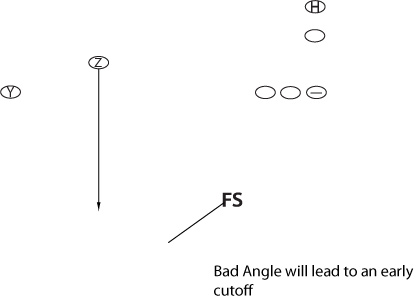
POOR ANGLE


This is the proper push angle. He should be at point with this type of leverage once the #2 WR pushes man coverage from the FS. This angle (if maintained) will allow the FS to play inside and vertical routes. A bad angle is a common mistake that many FS's make when first learning.


There might not be to much difference to the two angles at first, however the poor angle will get the FS in trouble if he gets an inside route (post or dig) from the #2 WR.

There is not as much of a problem if the # 2 WR runs a vertical route, but inside routes will be a problem. The aiming point of his angle should be past the cutoff point. The cutoff point is the point on the field where a WR will make his breaks inside or outside. It is usually at a distance 10-15 yards past the LOS. The diagram below will show the problem with redirecting from a bad angle.


This angle will make it too easy for the WR to beat the FS inside. From this point the FS will be out of phase in a chase position with no inside help. This is not middle field coverage. In this coverage inside routes must be properly leveraged to avoid giving up the big play.

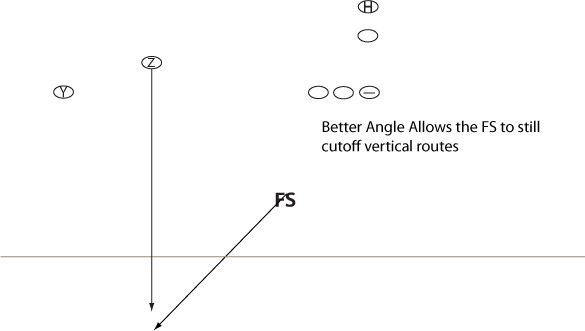
PROPER ANGLE

With the proper angle the FS will have adequate time to redirect and leverage both types of inside breaking routes.


The FS has more inside leverage on this coverage, and can see the route break-off with plenty of room to to allow for the proper recovery. This is the players main priority. It might make it harder to play corner routes, but he should have help from the corner there. This is a timeless football principal: LEVERAGE THE BALL TO WHERE YOU HAVE HELP.

This angle has benefits for the vertical route as well. If there is a speed mis-match, the FS has a better angle to cutoff the deep route.

This shows the FS cutting off the WR at the appropriate place on the field. There is still a chance the WR can cut inside but routes that deep are uncommon, the FS will have more time to recover, and the QB will probably thrown the ball the time the route gets this deep.

Below is some video of the proper angle and technique on a push. The FS is playing the TWINS WR's on the defensive left.


Even though the WR makes a break past the typical breaking point the FS should not worry too much about getting beat at this depth.

Wednesday, January 27, 2010

Robber Coverage Notes

I posted a reply on the Coach Huey boards about Robber Coverage. I will probably put a more detailed post with diagrams in the near future, but here is some more detailed technique on the coverage. This should be seen as a more in depth look at cover 2 (robber) technique from my original post on split safety coverage.

The biggest technique issues are for the the safeties: SS (Flat player) and FS (Robber).

VS Twin WR's

SS

Drop back and break to the flat if #2 releases outside. If number two release vertical past 8 yards, drop to flat and get under #1 and check if there is a back out (#3). If number #2 Releases inside get under #1 now and be aware of #3.

FS

#2 Release vertical, get in slow back pedal, if he passes 8 yards you have him man to man.

#2 Release inside, remain flat footed and read the depth of the release. If he releases under the linebackers, rob under #1. If he release above the LB's cut off and cover him now (think PAP/boot).

#2 Releases out-side. The eyes flash to #1. The key is to read the feet of the #1 WR. Most of the time one of three things will occur.

1. WR will buzz feet. FS Should rob curl to dig NOW.

2. WR will plant and drive at 45. FS Should roll into a position to cutoff the post.

3. WR Continues vertical. This is different from other peoples idea. The FS should flash his eyes to the QB and now "ROB" his eyes. Break on the ball. If the ball is thrown to the other side,break across the middle. The FS can't help the Corner when #1 releases vertical.

Tuesday, December 22, 2009

4-2-5 Split Field Coverage

I have read enough of these post and found them helpful and enjoyable. I thought I would try to contribute to the cause. Here is my first post.

You can find the TCU 1999 playbook here. There is not a whole lot of detail on the coverages but you can get a good idea for what they are trying to do. I have never visited with the coaches at TCU, only talked with others who run similar 4-2-5 defenses, so the terminology and alignments will not be exact, but within the general idea. I am going to discuss how to utilize a split safety coverage system versus spread offenses (2x2 and 3x1). These will be called out of 4-2-5 personnel. These will be different for a 4-3, because the COS is difficult.

In defense it helps to begin with the ordering of a coverage call. In this scheme the front call is irrelevant to the coverage the secondary is given. The call I will be discussing is 2-BLUE SOLO & 2-BLUE SPECIAL

The "2" Refers to the read side coverage. The read side is the side of the passing strength, and is the side that the SS and FS go to. The read side safeties will relay the coverage to the read corner and linebacker. The "BLUE" call is the away side coverage. This is the side away from the passing strength. The WS will let the away corner and linebacker know what the coverage is. The Diagram below shows it.


COVER 2

Cover 2 in this scheme is not the typical squat/halves (cloud) coverage that is quite common. Cover 2 is a robber scheme. There is a post about Virgina Tech's Robber coverage here. TCU's and Virgina Tech's are very similar.

To summarize robber. The FS will align o/s shade of the OT and 10 yards deep reading the linemen. On the snap of the ball the FS will remain flat footed until he get his read, on a run read he pursues the ball inside out. If he reads pass, his eyes flash to the #2 WR to the read side.

If #2 releases vertical past 8 yards the FS will yell "Push, "Push" and takes the WR man to man. If #2 releases out or in within 8 yards the FS will rob under #1 looking curl, post, dig.

The SS is responsible for the out cuts by #2 and if he gets a "push" call from the FS he will move to get under #1. The read corner aligns at 7-8 yards off LOS and bails playing a 1/2's technique over # 1.

BLUE


On the away side the WS and away corner are playing cover "BLUE". This is a type of combo man between the two of them. Both are reading the # 2 WR.

If the # 2 WR pushes vertical past 8 yards the WS takes him man to man and the corner locks up on #1.

If #2 releases outside within 8 yards the WS will make a "wheel" call to the corner. On a wheel call the corner Comes off and takes #2 man to man, and the WS locks up on #1 with over the top leverage.

If #2 releases inside the WS will yell "IN" "IN" to the linebacker and then double #1 with the corner.

The read and away sides respond differently to outside cuts by the #2 WR's. The picture below shows how each side will respond to the curl/flat combination.


SOLO


The final word of the call is SOLO. This is the trips coverage. This alerts the secondary that on any 3x1 formation the away side will check into SOLO.


SOLO is a trips check aimed at defending the trips side at the expense of putting the Corner on the single receiver side on an island man to man. The Read side continues to play Cover 2 on #1 and #2. The handeling of the #3 WR is done by the read side backer and WS. The WS has force/ pitch to his side. On pass, the WS sprints toward the middle of the field hunting for the # 3 WR. He has him Man to man. The read side linebacker's job is to wall #3, re-routing him and preventing a quick throw.

Versus a split play the coverage looks like this.


On the read side the FS makes a "Push" call and takes #2. The SS gets under #1, and the WS sprints across the field and takes #3. Below is another example.


This is an example where running 2-Solo is perfect. The play is designed to attack the trips side. The FS sees #2 release o/s and then robs the curl of #1. The SS drops to the flat and picks up #3, and the corner is deep to handle the wheel route by #2. If the QB is reading the corner and SS he will throw to the curl not realizing the FS is getting underneath it.


CHANGE OF STRENGTH (COS)

COS deals with motions that change the read side. This is one of the most troublesome things to deal with in this system. However, the presence of a third safety makes adjustments easier. Thats why this system is more difficult to run out of a 4-3 or 3-4. If the read side changes the FS moves to the other side, and the SS and WS swap responsibilities.


The read side flips to the right. The FS and WS play cover 2 and the SS checks his side into SOLO. After the motion the secondary is aligned like this.


The beauty of this is the adjustments were made by the secondary. The linebackers don't really have to move, only change responsibilities.

ANOTHER TRIPS COVERAGE "SPECIAL"

SOLO is designed to Load up on the trips side. You can run multiple coverages to the trips side with SOLO on the away side. You can put your read side into squat/halves, man, and BLUE. SOLO allows for flexibility in coverages to the trips side.

However, you might not always want to lock up on the single receiver side. You need a coverage call that allows for flexibility to that side too. That is where "Special" comes in. If the coverage is 2-BLUE- SPECIAL, your secondary checks into special with any 3x1 set.

Special puts the read side corner man to man on # 1. The SS and FS play #2 and #3 with BLUE coverage (Treating them like #1 and #2). The SS acts like the corner does in Blue and the FS acts like the WS. The other players disregard the #1 WR the corner has man to man. (This is an X-out concept. You could use a similar adjustment VS TE trips (trey) You can lock the SS on the TE and have the FS and corner play blue on #1 and #2.) This locks down that side and allows you to play games with your WS and away corner on the single receiver side. You have many options here. You can run different brackets, play squat/halves, Spy the QB with WS, or even send him on a blitz off the edge.


You can add a 4th tag to the call to let the WS and Corner know what to do vs trips, or have the WS look to the play caller for a call when he gets trips. It helps to have a base call for the away side in special. A simple bracket call works best for starters.

Special is also the call of choice versus an empty (3x2) set. Versus empty the FS checks Special to the trips side and the WS gets the away side into blue. This is a good coverage it provides great run support for draws and get all the WR's covered.


With 2, blue, solo, and special you can present a number of looks to the offense,have a plan to deal with the trips side and open side in 3x1 sets, and even cover empty (3x2) sets. The ability to play with 5 players in the secondary makes adjustments and communication simple.

Addition

I have written another post that goes into alignment details of split-field coverage versus 2x2, 3x1, empty backfields.