There are many teams that rely upon pull schemes to move the ball. These schemes create problems for defenses that try to play base gap control defense and read and react. Plays like the dart are troublesome for these schemes. Lets take a look at the couple of typical pull schemes that teams employ.
 This is the Dart and it has become a spread staple.
 This is a simple fold play.
If you look closely a problem is created. The gap the pulling linemen is going throw gets split into two. This is similar to the problem that the ISO creates. This extra gap gives flexibility to the running back. Usually teams try to leverage their backers to deal with this. However this is not a viable option because the backers create a huge cutback lane, if they do this. Consider these two plays with the backers leveraging the puller.

 Lets look at the the problem that is created. First off, consider the # of gaps that are needed to defend the running game.
There are six gaps and in this example we have 6 defenders to cover each of these gaps. So, whats the problem? The problem is that the offense moves where the gaps are on pull type plays.
 What makes it a problem for the defense is that the defense does not rearrange the way that the 6 gaps are defended. So essentially, a gap is left open for the ball carrier to run through. If there is 6 gaps and 6 defenders then how is there an open gap?
 The pulling scheme puts two players in one gap. The defense needs to avoid this. 2 defenders in one gap is a big problem. A simple and solid counter for these plays is needed. A good way to stop these plays is the fire the backers through their gaps. This allows them to penetrate the backfield before the pullers or double team get to them. However, firing your linebackers constantly is usually not the best idea (unless the team can't stop it).
Another way to defend this is have one of the linemen defeat the linemen at the point of attack. However, this is not the most reliable method year in and year out.
This was a long explanation of some simple plays, but I wanted to establish the problem the offense creates for the defense. The most effective way for countering an offensive concept is to look at the weakness of a particular scheme.
I was beating my head against the wall when I first started dealing with these plays, I tried to rearrange my fronts, stunt backers, and twist linemen. There would be some success, but I would leave myself open to other plays. It was a guessing game, but sooner or later I would get the defense out of position and give up a big play. I needed an effective counter that would remain sound against other plays.
What I realized was that both these plays relied on the guard base blocking the 3-technique one on one. I started slanting the 3-technique from B to A-Gap. This was a problem for guards to pick up because they did not expect a three technique to do this. If I had a tackle that had a problem with this technique, then I would cheat him back a step. This is not a hard technique to execute on defense, an it became my best defense for these types of plays. In one game the 3-tech had 6 tackles for a loss on this stunt.
The best part of it was, I was sound against everything else. The only change in the defensive scheme was that the backers had the B gaps.
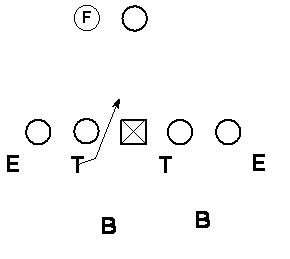
 If run effectively, the offense will have to get away from the single pull plays rely on counter OT or zone runs to get the ball going. I would rather face those plays. It allows the DE to spill the ball to the Outside guys.
This might seem like an overly simple adjustment. But I have found it to be one of the most effective ways to defend pull schemes. Teams have tried to counter it, but it more or less takes them out of pull schemes. Whenever you run a front with a 3 and a 1, the three technique draws a one on one block. This block is the weakness that the defense can take advantage of.
Even if you pull towards the 3 there is a one on one created. Consider this example.
 Still the 3-tech penetrating the A gap creates a problem for this play.
This might have been too long an explanation for such a simple adjustment, but I found it helpful to understand it this way.


