Thursday, April 29, 2010

Quarter Coverage- Safety Push Technique

A push is when the #2 receiver to a side pushes vertical and draws man to man coverage by the deep safety to his side. In my previous post on split safety coverage I briefly explained the rules of 2-Robber and Cover 4. In both coverages vertical releases by the #2 WR past 8 yards would put the FS (and WS) in Man to man coverage on the WR. A WR vertical release past 8 yards is known as a "push" call by the free safety.


Knowing the assignments and responsiblities of a coverage is important. However, knowing the technique to execute those assignments is even more important. The technique involved in a push by #2 is more detailed than many might think. There are many misconceptions of the technique. Also, there are many ways that people teach their safeties in a push situation.

FUNDAMENTALS

The goals of the FS coverage technique on a push by #2 has two primary goals:

1. Be in position to cutoff deep vertical routes.
2. Have good enough leverage to play inside cuts by the #2 WR effectively.

Outside cuts are not part of the goals in basic robber coverage. The flat defender or corner are covering outside, so the FS should not have to worry about those routes. He has help there. On the other hand he does not have inside or over the top help. Therefore, it only makes sense that he leverage those routes. So the starting point to proper coverage technique begins with the initial angle the FS takes towards covering the #2 WR.


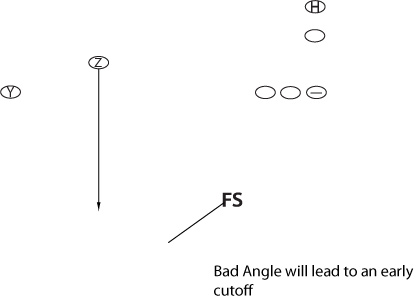
POOR ANGLE


This is the proper push angle. He should be at point with this type of leverage once the #2 WR pushes man coverage from the FS. This angle (if maintained) will allow the FS to play inside and vertical routes. A bad angle is a common mistake that many FS's make when first learning.


There might not be to much difference to the two angles at first, however the poor angle will get the FS in trouble if he gets an inside route (post or dig) from the #2 WR.

There is not as much of a problem if the # 2 WR runs a vertical route, but inside routes will be a problem. The aiming point of his angle should be past the cutoff point. The cutoff point is the point on the field where a WR will make his breaks inside or outside. It is usually at a distance 10-15 yards past the LOS. The diagram below will show the problem with redirecting from a bad angle.

This angle will make it too easy for the WR to beat the FS inside. From this point the FS will be out of phase in a chase position with no inside help. This is not middle field coverage. In this coverage inside routes must be properly leveraged to avoid giving up the big play.

PROPER ANGLE

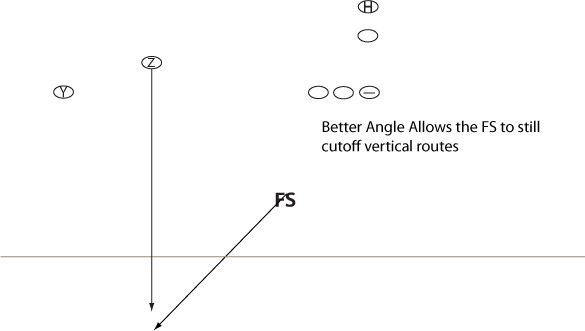
With the proper angle the FS will have adequate time to redirect and leverage both types of inside breaking routes.


The FS has more inside leverage on this coverage, and can see the route break-off with plenty of room to to allow for the proper recovery. This is the players main priority. It might make it harder to play corner routes, but he should have help from the corner there. This is a timeless football principal: LEVERAGE THE BALL TO WHERE YOU HAVE HELP.

This angle has benefits for the vertical route as well. If there is a speed mis-match, the FS has a better angle to cutoff the deep route.

This shows the FS cutting off the WR at the appropriate place on the field. There is still a chance the WR can cut inside but routes that deep are uncommon, the FS will have more time to recover, and the QB will probably thrown the ball the time the route gets this deep.

Below is some video of the proper angle and technique on a push. The FS is playing the TWINS WR's on the defensive left.


Even though the WR makes a break past the typical breaking point the FS should not worry too much about getting beat at this depth.

Tuesday, April 20, 2010

Quick Thoughts- Determining Coverages for a Defensive Scheme

The pro-I, wish-bone, and wing-t teams are not as common as they were in the 90's. Despite the fact that the spread is the current trend, high school defenses will still see a form of one of these run-offenses 2-5 times a year (sometimes more depending on the area). Good spread offenses force defenses to vary their coverage to keep themselves from getting exploited all day. The spread, due to it stress on spacing forces defenses to be conscious and aware of the windows and pass vulnerabilities that a coverage entails. While, traditional run offenses attacked coverages by the virtue of the coverage's force rules and run fits.

For example, lets consider squat/halves coverage (cloud force).

PRO-I TEAMS

Vs a squat corner many teams might attack the corner by utilizing a crack block on the safetyor backer coupled with a kick-out block by the full back on outside running plays. The pro-I coach is gonna use the wide positioning of the force player to create a wider running lane. This falls within the rules of the force player, fundamentally. A force player's job is to turn the ball back inside, but the angles the WR will have on the crack on the Safety or backer, and the fullback will have on the corner make this an excellent adjustment to squat/halves coverage.

SPREAD TEAMS

Spread teams don't think about run force vs squat/halves coverage as much as they think about pass coverage. This holds true for the run-heavy spread teams. Spread coaches, advocate "2-beaters" as the way to attack the coverage. Smash routes, fade/speed-out, and 2 outside verticals with a middle of the field split (post) route are just some the popular plays to attack squat/halves coverage.

THE MAIN POINT

No matter if you are facing mostly run heavy offense with only two wide-outs on the field or spread offense based from 4-wide formations; you are going to have mix up your coverages. Defenses facing the running sets are going to need a method to mix-up their run fits, and teams that face spread offenses are going to have to mix-up their pass zone responsibilities.


ORGANIZING COVERAGE

So of you reading, might be thinking," this is obvious! " Well, it is. But to what extent and in what way? Many coaches claim to be "Cover-2", "Cover 3", "Cover-4", "Man", or "Robber" coaches. Everyone has a coverage they like best and have bought into fully. However, seeing defense in this way limits the ability to mix it up, by making the idea of mixing up coverages scary.

The toughest dilemma for coaches is the goal to commit to getting good at one thing, versus limiting their effectiveness at that one thing in order to make time (room) for other things. The old phrase "Jack of all trades and master of none" is the hallmark phrase of this philosophy.

The mental block for coverage determination is the way we view coverage. Brophy's article about Nick Saban's Middle Field Coverage describe a great way to view coverage.

When you get down to it, there are really only two types of coverages in Saban's world;
  • middle of the field safety
  • split-safety coverage
When you teach a quarterback to read a defense, THIS is, afterall, what you teach him. From there, you can have 3 types of defenses;
  • man to man
  • zone
  • pattern match (after pattern distribution)

There really are two main forms of coverage.
1. Middle Field
2. Split Safety

Excluding man variations, which should be part of any team's coverage system, zone coverage falls into these two categories. Offenses have a general plan to attack each coverage type.

MIDDLE FIELD

Coaches will attack the stress player responsible for flat/force and the middle field safety. The vulnerabilities in this coverage are the seams and intermediate windows of the flat/curl areas. 4-verticals will stress your seams, and curl-flat and vertical-dig combinations will stress your flat/curls defenders.

SPLIT SAFETY

On pass coaches will attack the Middle of the Field. Squat/halves, quarters, and robber coverages are all susceptible to plays that attack the middle of the field. Split Safety coverage offers benefits that middle field coverage does not. It can provide better coverage on vertical/deep routes (exception is squat/halves) and more effective coverage on intermediate routes. However, the nature of split safety coverage allows offenses to run post routes that attack the middle of the field. This route is easier to throw and execute than deep vertical routes.

DETERMINING COVERAGE SCHEMES

Whether you are a Split Safety or Middle Field coverage coach, you cannot stay in just one of them. Obviously, if you have a talent advantage versus the opponents you play, you can possibly get away with it. But all things equal, good coaches are gonna exploit you. You have to use a favorable mixture of coverage calls to put the play-caller in a lose-lose situation. The economic concept of game theory can provide ideal ratios to optimize coverage calls. However, most of us don't have the time nor desire to calculate this. There is an easier way.

Step one is to recognize the vulnerabilities of your coverage. If you run split safety coverage 90% of the time, it is unreasonable to complain about people killing you on the post. No matter how well you teach your techniques, the natural advantage of attacking the middle of the field versus split safety coverage will be enough to get you burned more times than acceptable. On the other hand, it would be unreasonable to complain about intermediate routes and 4 verticals killing you in middle field coverage. The same reasoning applies to this.

Step two is to determine what play call ratio you ideally want to use and what ratio of time you will dedicate to practicing each concept. Some people will be more in favor of split safety coverage and others middle field. Whichever you choose, it is in you best interest to at least in concept involve adequate time for the other.

Remember the benefits and weaknesses of each. Fundamentally, using each one gives you a solid base to defend against offenses. In addition to this, properly mixing the two coverage types into your play calls, allows you to put more pressure on the offensive play-caller by making him guess whether you will be in middle field or split safety coverage.

CONCLUSION

This might ruffle some feathers, but this is just something I have observed. I have seen many defenses get burned by being too one-dimensional in their coverage scheme, and witnessed offenses get stuffed by less-talented teams that mix up the two concepts effectively.

Sunday, April 11, 2010

Defending the Counter- GT Part I

The counter is a staple plays that is run across many offensive philosophies. It is the hallmark of angle blocking teams. It can cause numerous problems for the defense, and put tremendous pressure on the d-line and backers. Stopping it is a priority for most teams, whether it is run from the I, wing-t, or spread. Defending it well requires sound alignment, gap-control, and a keen understanding of run-fits. The first step to defending it, involves understanding what the play is designed to do and what key things must happen in order for the offense to execute the play effectively.

STRATEGY OF THE COUNTER-GT

The counter blocking assignments are simple. One player is assigned to kick-out an edge defender (most likely a DE), another is designed to seal a linebacker, and the rest block down and away from the play. The backs job is to run between the kick-out and seal blocks.

The rules for the blocking are quite simple. The biggest thing the offense must determine is which player will be kicked out.

The key block in the play is the Double team of the play-side defensive tackle. Whether the tackle is a 3 or shade-nose makes no difference. The goal of the offense is to blast this player backward into the backside linebacker. The aiming point for the double team is to take the d-tackle past the center. This accomplishes two goals. One, it walls off the backside backer from pursuit, and two, it widens the running lane for the back and stresses the play-side defensive end and linebacker.


If the offense can create the above situation, the defense is in trouble. Determining how to defend the counter is irrelevant. Deciding between squeezing and spilling will make no difference, because the play is gonna gain yards period. Squeezing occurs when the "kick-out" defender squeezes down the line (with the down-block) and makes contact with the guard, keeping his outside shoulder free. The idea in a squeeze is to condense the running lane and push the ball to the linebackers. However, if the double team is able to push past the center the running lane cannot be condensed adequately.


Here the DE does a good job of squeezing, however the running lane is too large because of the double team. The back has enough room to make a cut off the seal on the linebacker. The backside backer cannot help stop this.

Spilling involves the DE and backer essentially trading responsibilities. The DE's goal is to get inside the kick-out and spill the play outside where the backer can make the play. Even with a good spill the counter can still go, if the double team pushes the d-tackle past the center.

Even on a good spill the DE has to much ground to cover to properly play inside the kick-out. The back simply needs to hug the line of his center and double team. The Seal block can easily get the linebacker despite the spill.


DEFENDING THE COUNTER

Handling the Double-Team

This might seem obvious to the typical reader, but is the most important principal when defending the counter. DO NOT ALLOW THE DOUBLE TEAM TO GET MOVEMENT ON THE D-TACKLE! This is a must, don't be stubborn about it. If the O-line is strong enough to drive your D-Tackle back, and no technique can prevent it, then have the tackle cut the linemen and create a pile. You cannot allow the offense to put stress on the play-side defenders.

Run Fits

Once you take care of the double team, you can begin to formulate a strategy of how you are going to defend the counter with your play-side defenders. The main ways are to squeeze and spill. Prior to determining those two techniques, it is important to know how your players will fit into the run. The basic run-fits are detailed below:

(these can change slightly when spilling if the Tackle runs around the guard)

Versus any kick/seal play the two offensive blockers create three running lanes or "gaps". A lane on the outside of each of them and one lane in between them. The idea for the offense is to ideally create an open lane in between them. For the defense, you must be able to place defenders in a position to defend these three areas. If you do not have these three covered the offense is gonna have a running lane. Here is an example of the run-fits if the defense chooses to squeeze. (More on the squeeze will be discussed in part 2)


Using this framework, it should be easy to diagnose the problem that occurs when the double-team pushes the d-tackle past the center. Lane #3 is undefended.

CONCLUSION

This is just an introduction into defending the Counter-GT. In this section, I talked about the goals of the offense, the most important priorities for the defense, and the principals for defending the play on the play-side. In part II I will go more in depth into the techniques and principals involved in squeezing an spilling.


Saturday, April 3, 2010

Cover Black- Inverted Man-Under Halves

Spread Teams put stress on the defense. The challenge of defending the pass and run effectively put the defense into difficult decisions. The need to stop the run while at the same time maintain excellent pass coverage is difficult. Zone coverage is the mainstay of choice vs the spread because of these needs. Zone allows all eyes to be on the run while coverage is developed to protect deep passes. Because of this, offenses attack defenses with quick/short, intermediate, and outside breaking routes. In response to this defenses have mixed in man coverage variations to deal with this attack.

Man coverage can take away short and inside breaking routes. Outside routes are harder to cover because of the inside-leverage defenders use in man coverage. In certain man coverages defenders can use outside-leverage. In order to use outside-leverage the defense needs to provide inside and/or deep support to remain sound. A popular coverage to use when the defense wants to defend the pass is man-under halves support.


In this coverage the players in man coverage will use a trail technique and the safeties will provide deep support. Any outside cut and intermediate inside cuts should be covered by the man defenders. However, there are two drawbacks to this coverage. First, the quick inside slants are hard to cover. The man defenders are out of position to cover these routes due to outside alignment and there isn't anyone that can provide immediate help to these routes. Second, run support is weak. The man defenders are too far from the action to provide adequate support and the safeties are gaining depth to provide deep pass support. This limits run support to 5 players. Given that the offense has 6 players to use in the running game, this puts the defense at a disadvantage versus the run. Due to these drawbacks the defense usually runs this coverage in long yardage situations where the threat of the slant and run is of less concern.

The does not put the defense in the best position, because the best coverage for deep to intermediate pass plays is restricted to long yardage downs. However, the offense can run these types of passes on any down. How can the defense improve this position? For one, the defense will need to utilize this coverage on situations other than long yardage. Another thing about today's spread offenses, is that they can check into different plays depending on what the defense gives them. This alignment will invite offenses to check into running plays.

The solution must then allow the defense to show this alignment but defend the run more effectively. If a defense can do this, then the offense will be in a guessing game. In short, the defense will have gained the upper hand. What type of coverage would this be? In comes Cover Black, an inverted man-under halves coverage.

COVER BLACK

Playing the Run

In cover black the defense shows the offense a man-under halves look and invites the run. The wrench in the works is that the defense has 7 players that it can commit to the run. The 2 extra run defenders are the safeties. The safeties need to stem to 1x8 alignment and flat-foot read thinking run 1st. On a run read the safeties can activate into the box quickly. Also, they will probably pursue freely because offenses do not account for the safeties in their run blocking schemes. This coverage is effective versus inside and outside running plays.

Versus the inside run

The linebacker is responsible for the A-gap. The FS sees the tackle move inside, so he move over to cover the QB pull. The WS sees the run action and activates to defend the B gap. The Defensive end leverages down the line and takes the back. If all goes as planned the QB will pull the ball not knowing that the FS will be in position to play him.

Versus the Option


Here the rules are little different. On fast flow the play side safety moves lateral and checks the slot receiver. If the slot releases towards him or vertical he needs to take away the play pass. The SS is man to man on the slot but begins with his eyes on the backfield. While jamming and disrupting the slot, he should trigger to run force whenever he sees fast-flow his way. The WS can protect the cutback by checking backside B-gap and then get into pursuit. The end can take QB.

Playing the Pass

The rules for the underneath man defenders are as follows.

1. Align o/s leverage on man
2. Maintain outside leverage and cover any outside cuts by your man
3. Stay over and outside your man on vertical releases.
4. If your man releases inside yell "in-in!" release him and continue to gain depth. (stay over the top in case he cuts vertical again. )
5. If you are covering a slot and your man is running a vertical route and you hear the corner make an "in" call, work inside your man. (You will not have post help anymore)

The biggest challenge is number 5. However, this is not a play type that people will run at a man under halves look.

Safety Pass Rules

1. Don't chase a shallow crosser. A shallow cross is a route that is below linebacker depth.
2. You have the 1st inside cut (past linebacker depth) of speed (don't take an inside cut by a TE).

Lets look at some diagrams of cover black in action.

Versus a Dig Post Combination

Basic rules application here. The SS makes his "in" call and gains depth. The corner should alert the SS to his inside cut so that he (the SS) can cutoff the route while the corner plays the route over the top. The FS will handle the dig.

Versus Vertical and Dig


This is an example where the SS will have to work inside his receiver. The corner will make an "in in" call. This alerts the SS that he has lost his post help, but will have outside from the corner. An important coaching point with this technique, is that the SS must work inside by going over the WR. He should be over and outside initially. It is problematic for him to work inside by going behind the WR, because if the WR cuts inside (ie Post) before the SS gets inside the WR will be wide open and have an easy lane to go the distance.


Versus the Deep Out by #1


The idea for the offense is to wall of the SS from getting underneath the out by #1. They run this when they expect the corner to bail and play deep zone. Versus man the route becomes more of a comeback. This coverage will look like zone to the WR's so they will try to wall with the slot.

Teams will not want to run a deep out to #1 versus this coverage, but lets talk about the technique to take this away.

The SS has to maintain outside leverage and remain over the top when the route pushes vertical. The FS should shuffle and look for inside cuts. The corner should stay outside and over, break aggressively outside as soon as the receiver breaks out. Due to leverage the corner is in perfect position to cover this route. The only difficulty will be if the QB throws the ball the WR's inside shoulder.

It is important for the SS to maintain proper leverage in this play, because he will be in perfect position to cover a corner route by the slot.


CONCLUSION


Cover Black is a great and deceptive coverage. It is a great change-up and stand alone coverage that can be run on any down. It is especially useful when your defense employs man-under halves. The offense will not be sure what coverage you are in when you align in this look. You can utilize man-under coverage on more than just long yardage situations when you have cover black as a change up.

Defending the Slot-T Offense Part I

The slot-t misdirection offense is a difficult offense to defend. It places 11 players in close proximity to the ball and forces the defense to play slow. It's misdirection can throw a defense into chaos if they don't have their eyes in the proper place. The base alignment of the offense is shown below.


There are multiple ways to align, and it is recommended that you show multiple alignments when you are facing the slot-t. The offense is based on rules. The line makes blocking calls to execute their plays. If you can stem and show different pictures, you will confuse their blocking assignments.

The offense functions on a series system. Meaning a certain range of plays are utilized within a given series. There are various series that can be run. I will look at 4 series in these posts on defending the slot-t offense.

1. 100's
2. 200's
3. 300's
4. 400's

These four series comprise the majority of what this offense will run and also encompasses their base plays. The rest of the series for the most part are adjustments and can change depending on the year.

READS AND KEYS

On defense the starting point is reads and keys. If these are off, you are in for a long night. There are two main key types: Backfield and Linemen. This offense thrives on defenses that read their backfield. The misdirection alone gets backers out of position constantly. Vs this offense line keys are more effective and will get players into better position consistently.

Line keys are best the majority of the time, however, there are times when reading a certain player in the backfield is more effective. How do we know when to read backs? Easy, the best time to read backs is when the offense is running a particular series, the 200 to be exact.

DEFENDING THE 200 SERIES

The 200 series begins on the 2nd "hut" meaning all of these plays happen on 2. The first "hut" puts the z-back in motion.


When this occurs one of three plays will usually happen. In general terms, they are called F-Wham, Z-Pitch, and H-Trap. Using diagrams from the actual playbook:


F-Wham


The F gets a dive and the H leads him.

Z-Pitch


QB fakes to the F then pitches the ball to the Z.

H-Trap


H delays then takes hand-off once the F clears.

The last play needs more explanation. The left tackle will influence the defender by showing pass, then release to the backer. The Right tackle pulls to kick-out the defender. The H delays then opens to take the hand-off and run behind the trap. This play is especially devastating if your players are favoring the pitch.

Reads vs the 200 Series

As I said earlier the best thing to read is the line preferably the guards. This offenses uses lots of pulling by these players, so you can rely on the guards to take you to the ball. However, this is not the case in the 200 series. The guards do almost the same thing each time. The most reliable key in the 200 Series is the H-Back.


Once the Z goes in motion on the first "hut" the backers eye's should immediately go to the H-back. He plays a crucial role in the execution of these 3 plays. In the F-Wham he lead blocks for the F. On the Z-Pitch he leads outside for the Z, and on the H-Trap he gets the ball and runs opposite the flow. Also, only on the H-trap does a linemen pull, and it is a tackle who pulls. Since the preferred read is not the tackle, it will be hard to read the trap by keying linemen.

Let look at the movement of the H in respect to each play.


As you can see from the above diagrams the H will take you to the play in this series.


CONCLUSION

This is just an introduction and an explanation of when to read the backfield vs the slot-t. In the next part I will analyze the 300 series and explain what to look for with the line keys. The other parts will cover pass defense and overall game-planning.

Friday, March 26, 2010

46 Defense- Cover 7

The 46 Defense designed by Buddy Ryan and evolved further through the work of current Jets Head Coach Rex contains many concepts that could be incorporated into different schemes. I know many coaches still operate for the most part out of a 1-High Middle of the Field Coverage look. In this shell the main coverages are 3-deep zone and man free. There are some things you can do, like roll the secondary into 2-deep coverage, but most people in “1-high looks” prefer to play 1-high coverage.

Buddy Ryan utilized multiple coverages in his 46 package. In addition to basic cover 3 and man-free, he integrated a number of rotation coverages each with multiple variations. The coverage I will be discussing today is “Cover-7” which is a (man-under halves) weak-side rotation coverage.


Base Rules


Coverage on the Wide-outs

The WS rolls to the weak ½ while the strong-side corner plays “thumbs” technique that involves him opening to the other ½. The other part of the thumbs is the jack backer getting underneath #1 and playing an inside-trail technique on the receiver. His job is to cover the inside cuts (and provide solid support on outside cuts) forcing the ball deep and outside to the deep corner.

Weak Corner and WS can play different games on the #1 WR. The options for them are:

  1. Fist
  2. Slice
  3. Fist/Slice

Fist is basic inside trail bracket coverage. The Corner lets the receiver get ahead while he trails him 1 yard behind and 1 yard inside. His key here is the WR’s hips (or feet). He is responsible for underneath coverage of the WR. The WS plays over the top and is responsible for deep to deep-outside routes.

Slice is outside bracket. In Coach Ryan’s playbook slice technique is described: “The corner drives through any outside break, and the Safety drives through any inside break.” It is used as an automatic inside the 20 yard line.

Fist/Slice is an interesting adjustment. Is a unique bracket that works well against a slot WR (but good on a single WR). The corner forces the WR outside (same as fist) then crosses over him to a point 3 yards outside and even with the WR. This is a difficult read for the offense because the corner appears to be denying the inside breaks while inviting the outside breaks. However, after the initial jam, the corner works to take away any outside breaks. This is a great adjustment to teams whom like to run the “choice” route to the open side. The big question in this technique is how to properly defend inside cuts. Here the WS has inside cuts by #1. He should be aware of deep routes, but must play the inside breaks aggressively. The only problem with the aggressive play of the WS versus the inside breaks is the threat of the double move (i.e. Slant-go). The corner must help out with these situations. In Fist/Slice the corner must get over the top of #1 anytime he breaks inside to the WS. This is why the corner must play the WR outside and even, so he is in a position to get over the top of inside cuts. This technique allows the WS to play inside breaks very aggressively.


Coverage of the Middle 3


I have covered the bracket techniques used on the WR’s to each side. The remaining three eligible receivers require a coverage system. The Strong Safety, Mike, and Charlie have this responsibility. Their options are:

  1. Frank
  2. Zebra
  3. 3-Way

These coverages are varied techniques that alert the player for lock-man, 2-man combo, or 3-man combo responsibilities. Frank is very basic; the player has his assigned person in straight lock-man. There is no exchanging; you follow the receiver to the stands if he goes there. In the diagram below the SS has the slot man to man. There are times you can put the corner in Frank technique and allow the SS to play the brackets with the WS, but I will not discuss the variations here.

Zebra is a combo (banjo) coverage, this is common to most teams that run man coverage. In the above diagram the Charlie and Mike banjo the TE and back. Zebra is basically an alert for a possible 2/3 switch.

3-Way coverage is an alert for a 3-man exchange and more importantly a play action strong. On play-action the Charlie would have 1st man out, the SS would have the first crosser (the Mike would pass him off ), and the Mike would play the man in between the two.

Anytime the backers are not in 3-way, they must be aware of which of one is in Frank. Usually, if a player is in a frank technique, the other two are in zebra.


Adjustments


Like any coverage, there are going to be prepared adjustments for certain formations. Formations like wing-trips (12 personnel) create conflicts with the linebacker.


The Charlie and Mike are not in position to cover the 3 receivers. If the wing releases flat and the TE runs a corner, there are going to be problems. First, the Charlie would be responsible for the #2 WR (wing) but could easily get walled by the TE because of alignment. Second, the Mike will have difficulty getting underneath the TE. Besides checking to a different coverage, there needs to be more effective way of handling this Set.


The “I’m Out” Call


This call involves the Jack and Mike swapping responsibilities. The Jack now plays man with the Charlie and Strong Safety. He will now be in either frank, zebra, or 3-way. The Mike is now the player in “thumbs” playing inside-trail on the #1 WR. The full adjustment looks like this:

The drawback here is the positioning of the Mike in respect to the #1 WR. He has more distance to cover to get in proper trail relationship on #1. However, the defense is in a better position to leverage the routes of the middle three wide receivers. Even versus some problematic formations, this coverage can involve simple adjustments and remain sound.


Situations to Check out of Cover-7


Cover-7 is used to aggressively attack and take away underneath routes. It is most effective against 1 receiver to each side and a combination of the other 3 players in running-back or TE alignments. As a basic rule of thumb, cover 7 can be run whenever 3 eligible receivers are aligned in close proximity to the core of the formation and there is a wide receiver to each side. There is more to it than that, and spread formations/tight end trips/twins variations will take the 46 defense out of cover 7. The purpose of this coverage is to provide aggressive underneath coverage versus sets with a wide-out to each side.


Summary


Cover-7 is nothing new to football. Coach Ryan ran this coverage in the 1980’s. This era was dominated by running formations. Despite the fact that spread formations were not as big an issue, Ryan found a way to get his defense into a 2-High coverage from a 1-High shell. In addition to just getting into the coverage, he crafted a simple and effective way to change up the way he did his rotation coverage. This illustrates a timeless principal. For every coverage concept you have, it helps to have simple and alternative ways of running it. If you are a cover 3 person, it helps to change up which players have flats, Curls, and middle thirds. The 4-spoke, 3 deep rotation coverage are examples of this.

No matter the types of formations you see, you will always have to disguise and confuse the offense. Cover-7 is a great change up coverage that can be easily run out of a run-stopping front like the 46.

Tuesday, March 2, 2010

Pattern Reading vs Spot Dropping

This is a debate I deal with on a regular basis. What type of zone coverage is more effective for high school athletes. Most (if not all) colleges employ some form of pattern-match coverage. However, many high school coaches believe that this type of coverage is difficult for high school athletes to preform. In this post I will explore the pro's and con's of each.


Spot Dropping Defined

Spot dropping is just what it sounds like. On a pass read, pass defenders begin to drop back toward landmarks on the field. Terms like "Top of the numbers" "hash" , and "middle of the field" are used as horizontal markers. Then a depth is usually assigned. For example, a hook to curl linebacker could have a landmark 12-14 yards deep.

While on their landmark and in the process of dropping there, players have their head on a "swivel" reading the QB's eyes while they get to their landmark. In this scheme coaches emphasize two main things:

1. Break on the Ball
2. Gain depth

Pros
  • Simple to teach
  • Simple to execute
  • More eyes are on the ball
  • Better pursuit
  • Poor throws can easily be intercepted
Cons
  • Defenders can be stuck covering grass
  • There are many windows in the defense
  • Requires a better than average pass rush
  • A proficient passing team can slice you apart
  • Very susceptible to Intermediate routes.

Pattern Matching Defined


Rather than take your drop to a spot and wait for receivers to arrive, pattern-match coverage involves taking coverage to the most dangerous threat a defender recognizes in his zone. In this coverage defenders are taught to key certain receivers when they read pass. Usually, it is the #2 WR to their side. From the receivers action, they can diagnose whom the most likely threat to their zone is.

After a certain point, pattern-match coverage turns into man coverage. The aim of this coverage is to get the best of both worlds. Zone offers defenders the advantage of having their eyes in the backfield playing the run before the have to commit to the pass. On the other hand, man coverage puts defenders in the dark as far as the run goes, they are dialed in on the WR that they have in coverage. Pattern-reading uses zone principals early, and man principals late.


Pros
  • Fewer windows
  • Fewer completions
  • Ability to play run and cover intermediate routes
  • Defender aren't stuck covering grass
  • confusing for the quarterback
Cons
  • QB scrambles could hurt
  • Takes more time to teach initially
  • Fewer interceptions
  • more susceptible to the big play
  • more potential mismatches.

Are the Two Coverages Mutually Exclusive?


Is there a team that is purely a spot drop team or purely a pattern match team? I don't think so. In today's game of spread out offenses, no team will survive with traditional spot dropping. Conversely, in pattern matching the defenders know the general area that their coverage will be in.

In spot-dropping the underneath defenders are taught to see the QB as well as the WR's that could cross their zones. There are times the defenders are told to collision or re-route receivers. This is a principals at the heart of pattern matching.


My Position


These modern offense requires defenses to adjust. The same old style of defense is not gonna work the same way. As one side evolves the other side must as well. I am a firm believer in pattern reading. It just make sense in today's game.

The main argument against pattern-matching is difficulty. Many coaches argue that it is too difficult and that typical high school athletes cannot handle it. They reason along these lines. "Spot dropping is easier than pattern-matching. Our players are making mistakes spot dropping. So how can they begin to understand pattern reading?" The other line of reasoning involves the capability of high school athletes. Many critics question a players ability to see all these routes. I agree that at time it may appear like a lot, but like anything in football, it can be taught if you perfect the way you are going to teach it.

Training the Eyes

When making any type of "reads" in football, it all boils down to the eyes. There needs to be methodology to where a players eyes are supposed to be looking and how they respond to what they see. The more clear we can be with the progression of a players eyes, their ability to diagnose a situation, and trigger the appropriate response; the better we can all be at coaching defense. In the analysis below, the focus will be on underneath droppers, not the deep defenders.

Eyes in Spot Dropping


First, eyes begin on the run/pass key. The most common keys are linemen and running back. Regardless of the key, the player should be able to diagnose run/pass and then move on to the next action. If the defender reads pass, the player should open to his landmark and begin dropping. The eyes should go to the QB second to diagnose the drop type. (On sprint out flow rules usually trigger) On straight drop back plays the linebacker continues towards his landmark reading the QB back to his landmark on the "swivel". This is the basic way of spot dropping. Most coaches have tried to incorporate reads into their drops. However, this is where problems have occurred. The problem is usually a rules conflict.

This conflict stems from two primary goals of spot dropping. First, is the ability to see the QB so the defender can break on the ball. Second, is to gain depth. This is done to prevent an intermediate route from getting wide open. The philosophy is that if the player can accomplish goal #1 and goal#2 then the only open passes should be shallow routes. Shallow routes are not a big concern, because the underneath defenders will be able to see the QB release the ball. This allows the players to break forward and keep the play to a minimal gain. However it usually does not work this way.

Intermediate routes become open anyway. The defenders are so busy focusing their eyes on the landmark and QB that they don't know where the intermediate receiver is going to be. By the time they "break on the ball" they are usually out of position to make a play on it. Coaches begin adjusting their drop rules and involve pattern read concepts. They try to train their players to see these routes developing. Many times these players learn how to do this. However, the rules conflict rears its ugly head. When you begin to involve reads two things usually happen. First, the defenders do not see the QB as well and the "break on the ball" is not as good. Second, depth suffers because droppers will stop and delay more when reading routes.

This angers the traditional spot-drop coaches, because they have always emphasized breaking on the ball and gaining depth. They have the habit of emphasizing these top two goals. The main problem is there is no clear process of where a players eyes go. In traditional spot-dropping the eyes are simple: swivel from the QB to the landmark. If you begin to involve reads into this system and emphasize these two goals the same way, then conflicts will be present. Spot-dropping will become more difficult and frustrating then before. I am not saying all spot-dropping coaches go through this. I am noting this because it is a trap that is easy to fall into.

Whenever you begin integrating route-read concepts into a spot drop philosophy, players will not drop to depth as consistently nor break on the ball as quickly.


Eyes in Pattern Reading

Similarly to spot dropping, eyes begin on run/pass keys. Once reading pass, the eyes go to a completely different place than their spot-drop counter parts. The body begins dropping in a predetermined direction, but the eyes flash to a particular receiver. Depending on what that receiver does the eyes could move somewhere else and/or the direction of the drop can alter quite a bit. Players are usually given a 3/2 drop or 2/1 drop. These are forms of "Hook to Curl" and "Curl to Flat". Here is an example

A 3/2 drop is usually an inside linebacker. On pass he opens at 45* and reads #3 (usually the RB) if he releases vertical he has him man to man. This is simple, on pass look at #3 if he goes deep you run with him. If #2 blocks or releases outside, the backer expands his eyes to #2. If #2 is running vertical, the backer walls him off and gets his eyes on #1. In this step he is anticipating #1 to make an inside cut (curl or dig route). If #1 continues vertical past 15 yards his final read is the QB, his technique to break down and rob the QB's eyes. This is not an exhaustive list, just a simple example of eye progression in pattern-matching. To Recap the linebackers eyes:

3/2 Pattern-Drop Eye Progression

1. Run/Pass Key
2. #3
3. #2
4.#1
5. Rob the quarterback's eyes

This is an example of cover 3 rules. In Cover 3, it is difficult for the inside linebacker to get underneath curl routes in a spot-drop scheme. But, in pattern reading the reads take the backer to the curl, to the point that he is anticipating the route. It is easier to get coverage on the route because the backer will have his eyes on the receiver.

At first this may seem like a lot to someone unfamiliar with this type of coverage. With enough time and understanding it becomes easy to coach. The key is emphasizing the progression of the players eyes and the recognition of what to do. This only requires simple terminology and efficient drills.

In this philosophy, you don't have to talk about routes in the general sense. Terms like slant, hitch, dig, and arrow can confuse the process. You only need to talk about receivers and their movements. If a player makes a mistake on his reads, the process is simple to correct. Questions are the key. Using the example of the 3/2 drop discussed above: if a player failed to cover #1 on a curl, what was the problem. He probably never got his eyes on #1. Ask him, "what did #1 do?" He won't know. Players will gain confidence in this system, because through repetition, reading a route progression will become second nature.

One major drawback to pattern-matching is that there will be fewer interceptions. Turnovers are a big key on defense. You have to weigh it with the benefits. The increased coverage will lower receptions and scoring. As a coach you have to decide what best fits you.


Summary

As the game changes so must we. High school teams have become more effective at passing the balls. If you try to play the same old keep the ball in front of you and break on the philosophy, you are going to get exploited. Spot dropping has its merits, but when you play in a league with proficient passing teams, you are gonna have trouble. Offensive coaches have done a great job.

Pattern-matching can make a tremondous difference for your team, if you commit to installing it. High School athletes can handle it. I once worked with 8th graders in the offseason, and showed them how to read routes. After a week it became easy for them. They would play 7on7 and have the routes covered. They even would talk to eachother with the proper terminology. The 2/1 dropper would yell at the 3/2 guy and say "Why did he catch the ball? #3 released out and #2 came in at you."

If spot dropping works for you and you are having success with, then by all means commit to it. A scheme is as good as its effectiveness. As coaches it helps to understand the different things teams are trying to do. Down the road coverage will probably take another evolution, because offenses will begin adjusting to pattern matching even more at the high school level.