Monday, May 31, 2010

Defensive Fundamentals: Training the Eyes

In my post about "Pattern Reading vs Spot Dropping" I briefly talked about the importance of training a defenders eyes.


When making any type of "reads" in football, it all boils down to the eyes. There needs to be methodology to where a players eyes are supposed to be looking and how they respond to what they see. The more clear we can be with the progression of a players eyes, their ability to diagnose a situation, and trigger the appropriate response; the better we can all be at coaching defense.
Determining a progression for the eyes to follow coupled with a set of movements (responses) is the key to effective defensive football. All positions on defense can involve this principal. In this post, I will look at different positions and describe possible eye movements and progressions.

Why the Eyes?

The #1 mistake on defense is a player having his eyes in the wrong place. No matter how well a player is taught to shed blocks, break and intercept passes, or form tackle, it can all be for nothing if the players eyes are in the wrong place. The various techniques we teach to our players are intended to be used during a particular situation. Few techniques (like back pedal steps) are used on every play. The majority of these techniques are situational. What good is squeezing a down block on a pass play? Or dropping to the flat on a run play? Neither of these techniques would be good because they are inappropriate for the situation.

What tells a player the appropriate technique for a particular situation? Some type of visual cue. Players execute their techniques more effectively when they begin to make the connection of a visual cue with the desired technique to execute at a faster rate. The single most important point to training the eyes, is it will allow a player to execute their various techniques in the appropriate situations at a fast rate. This type of mental/physical conditioning process is what allows players to play fast, and the key to consistent execution come game time.

In this post, I will look at 3 different positions and describe possible eye movements and progressions.

1. Middle Field Coverage-Free Safety

Run: Alley Player Inside Out
Pass: Middle 1/3

I have discussed part of this technique already, but I will begin here with initial pre-snap eye keys. Player should align in the middle of the field and then get his eyes on the center or most visible offensive linemen. At the snap the FS should get into a backpedal and read the center for run/pass.

Eyes on Run Plays : If the linemen attacks aggressively forward, the safety should immediately get his eyes in the backfield to diagnose the direction of the run flow. Upon identifying the flow, he should Plant, point, and drive towards the ball carrier on an inside out path. On his pursuit he should keep his eyes on the ball carriers inside hip and maintain vision on a path that has the ball carrier inside and in front of him.

Eyes on Pass Plays: When the linemen key works backward (indicating a pass) The FS should maintain his backpedal and immediately get his eyes on the QB's non-throwing arm. He is looking for the long-arm of the QB. Upon Reading the long-arm the FS must intercept the pass with his eyes. This means he needs to locate the place on the field he needs to break to in order to make a play at the pass. Upon locating this position he should take a straight line to this spot. While in pursuit he should swivel his eye's from his aiming point back to the ball.

---- This is a simple progression of eyes that will keep the Safety in proper position. Must busts that the free safety makes will be one of two things. A. The player did not have his eyes on the proper place. B. A misread will prevent the player from executing the proper technique.

2. Press-Man-- Corner

After aligning properly inside, the corner will put his eyes on the inside hip of the WR. The corner is a dedicate pass player and will only play the run if #1 he FEELS the WR trying to block him (a good WR will run him off, so I don't plan for this too often) or he hears his FS or coach yell "Run, Run." Baring those non visual exceptions the corner will have eyes on the inside hip initially. He has 4 different techniques to execute in man coverage.

- Release
-Jam
-In-phase
-Out-of-Phase

The release phase begins with initial steps by the WR. During this phase the corner will use slide steps to move vertically and replace steps to move laterally. These steps are used to keep in the proper inside relationship with the WR. The corner is keying the hip because it is a true read for him. The WR's feet, chest, and head are all more misleading than the inside hip. What he is looking for from the hip, is for it to commit. When the hip commits the corner is now in the jam phase. When the hip commits it turns and breaks a 45 Degree barrier. Upon reading a commitment of the hip, the corner gets his eyes on the near number (pec) of the WR and jams it with his off hand while opening his hips. The opening of the hips and off-hand jam are designed to keep the corner on top of the WR.

For example, we will assume the WR releases outside. Once the initial jam is done, the corner must assess his position on the WR. Can he see the near number of the WR or not? If he can, he is in-phase, and his eyes will focus on the WR's eyes with his peripheral vision on the V of the WR's neck. If the WR's eyes turn to look for the ball, the corner turns to play the ball as well. If his eyes and V of the neck turn back, then the ball is under-thrown. The corner needs to basketball block the WR from coming to the ball while making a play on it himself.

If the corner cannot see the near number after the jam phase, then he is out of phase. His eyes will not leave the WR until the whistle. He will key the WR hands. If the hand move to catch the ball, then the corner will wait for a "1000-1" count then rake the WR's hands.

----------- Mistakes like opening the hips the wrong way, wrong hand on the jam, getting beat off the line, and allowing an easy catch are all problems that start with the eyes. Corners get beat inside on slants when their eyes migrate up to the WR's chest. Many catches are made when a corner is out-of phase with a WR and then peeks back to find the ball. These techniques are not very effective if the eyes are undisciplined.

3. Defensive end in a loose 5 technique

C-Gap Player
Technique: Squeeze on down-blocks, does not get reached, Spills the ball on pulling plays, Outside contain on pass.

After he aligns outside the offensive tackle the end will key the feet of the offensive linemen. He is trying to identify which foot the linemen will step with.

If the linemen steps with his inside foot, he is trying to down or scoop block another defender. Upon reading this the d-end should step laterally with his inside foot and squeeze the down-block. While squeezing down the line his eyes should peak down the line for any pulling lineman. If a pull is coming he must attack the inside shoulder of the linemen with his outside arm. If he does not see a puller, he gets his eyes on the backfield, he will take the running back on any read option.

If the linemen steps with his outside foot the end will step with his outside foot. He continue to read the feet for the second step. Is the lineman's feet working backward, toward, or around you. These cues will alert the end to what type of block he is facing. If the feet are working backward it is a pass block, this tells the end to get up-field and rush the passer. If the feet work toward him, he is getting a drive block, he must stay low and hold his ground. Now his eyes flash to the backfield to locate the ball carrier. He will remain in his C-Gap until the ball commits away from it. Finally, if the feet are working to get around him, he is facing a reach block. He must work his hips around the blocker and hold his gap integrity.

--------------Again eyes here are crucial. Defensive ends who run up-field on down-blocks are a major problem for 4 man fronts. This problem opens up huge running lanes for counters and options. This problem is a lack of focus with the eyes. When I see this on film, the d-end usually has his eyes on the backfield and can't see the down-block. Another error is a slow-pass rush. This is a problem that coaches who over-emphasize the need to attack the linemen. Some ends will be so focused on attacking the linemen that they take to long to recognize that it is a pass play. By the time he knows it the QB has had time to settle in the pocket and begin his throwing motion.

Conclusion

These are just 3 quick examples. Every position and technique in defensive football begins with reads. The key to good reads are the eyes. If you focus on the eyes of your players you will see a dramatic improvement. The eyes are the link that we have from reads to techniques. The better we are at coaching this process and emphasizing it to our players, the better our team's overall performances will be.

Sunday, May 23, 2010

Zone Coverage Technique-Reading the QB

In pure zone coverage techniques that involve reading the QB, there are benefits and drawbacks. to it. The benefit is the ability to see the ball and ultimately take advantage of poor throws. The drawbacks are the precense of windows the QB can hit, given the lack of sight on the WR's. I have gone into detail on this on a previous post. However, even the biggest proponents of pattern reading have certain coverages that involve players that read the QB. First, any coverage that involves corners that bail at the snap, do best to involve some type of QB read to gauge the type of pass (3 vs 5 step). Any Middle Field Coverage, involves a FS that stays in his zone in the middle of the field while he reads the QB for an indication to break.


Another drawback to reading the QB in pure zone techniques is the QB's ability to look off a defender and then throw the ball the other way. For example, in cover 3 the FS drops down the middle of the field reading the QB. The most difficult play for this player to cover is the 4 verticals (double seam). QB's are taught to look one way and give a pump fake to get the FS to break before throwing the ball to the other WR, that the FS can't recover on. This creates a problem. On one hand, you cannot tell the FS to break when he sees the ball leaves the QB's hand, this will be too slow more often than not. On the other hand, you can't give advice like "don't fall for the first fake" or the like. The worst thing you can do to a FS in MOF coverage is slow down his breaks. The effectiveness of the coverage relys upon the FS's ability to break on the ball well.


Is there another solution? Yes! The key is in finding a reliable key to read on the QB that indicates a throw is about to occur. This key needs to be present only when the QB is going to throw and not part of the pump fake. Reading the QB's eyes is not reliable in cover 3 for the FS, because he can be looked-off. Reading the ball is no good, because A, the pump fake can get you and B, waiting until the ball leaves his hand will be too slow.


The solution is to read the QB's non-throwing arm. Teaching the FS (or any other pure zone dropper) to read the long-arm is an effective technique. The FS should break when he sees the QB's arm go long (or lengthen). The typical QB does not pump-fake with his off arm extended. The only active arm in a pump fake is the throwing arm (unless the QB pump-fakes with both hands on the ball, still there is no long arm in this type of fake). The long-arm is the motion a QB makes when his off hand creates separation from his body. This separation happens in the beginning stages of a QB's throwing motion. Have you ever tried throwing the ball with your off hand stuck on your body? Try it sometime, it is pretty difficult. Have you ever tried pump-faking with your off arm extended, its possible but it will throw off your throwing rhythm. Most QB's do not have the adequate time nor patience to develop this type of pump fake.

Another benefit of reading the long-arm is the indication of where the ball is going. The further the off-arm is from pointing at you, the further you have to break, this lets the player somewhat know what angle he needs to break on the ball at. He does not have to wait to see the ball in the air to know what angle the ball will be going.


Some QB's show a clear extension of the arm. Look at Carson Palmer below:


Others might not be as obvious, but will still show an extension of the arm when beginning the throwing motion, even Peyton Manning:


Try this out and practice this with your players. I have integrated this into our cover three technique and seen tremendous results. QB's can no longer look us off and we have a breaking key that allows us to get in motion before the ball leaves the QB's hand. This read can be equally effective with underneath droppers and corners.

Friday, May 7, 2010

Defending the Slot-T Part II: The Trap

I covered the 200 series as the time when the players should read backs. However, the most popular series of the slot-t is the 3oo series

The most popular play in the series is the trap. The 300 series begins with a trap motion, followed by two sweep motions. The base play is the TRAP.


Slot-T coaches love the trap. The idea of doubling down and kicking a player out is like music to their ears. The trap will be the first play they try to establish. This play is quick hitting, if done right the play will happen so fast, you might not even see the hand-off in real time.

IDENTIFYING AND STOPPING THE TRAP


The slot t uses alignments to their advantage. On the trap the alignment can be very obvious.


You must teach your d-tackles to read the alignment of the guards in relation to the center. In the picture above the left guard widens out to widen the 3-technique out. The right guard tightens his split and moves a foot back. This alignment makes the trap much easier to execute. This alignment makes the trapping of three a simple process. The nose cannot interfer with the guard pulling and the three (by alignment) will not be able to prevent the guard from trapping him effectively because of the spacing the offensive line created.


The first step to stopping this play is to recognize the alignments. The second step is to teach proper technique to the linemen. In this front the nose is in a position to stop this play.


If those nose can feel the down block and spin back into the play he can stop the play cold.

Under Front- Simple Nose Technique

The under front (also called weak eagle) is an excellent front to defend the run, pass, and to put general pressure on the offense. In high school and especially lower level athletics, it becomes a major problem finding people to fit our schemes year in an year out.

I am confident that no matter what, I can fit players into my under-front defense. In the worst case scenario I can get the defensive front going if I can find ONE solid linebacker and a shade nose that can draw a double team.

WEAK EAGLE ALIGNMENT

The nose aligns to the strong side with an end in a 5 and a linebacker in a 9. On the weak side there is a 3-technique and and a loose 5. The key to making this defense go is finding a decent linebacker and a nose that can draw a double team.

Many people got away from the eagle front because it was difficult to find a nose to draw the double team. This is reasonable, because the defense will collapse if the nose cannot draw a double team. The double team that the nose needs to draw is from the center and the strong side guard. If these two players can be tied up to blocking the nose, then the defense is in a good position. This is beneficial for 3 reasons:

1. The backers are free to pursue the ball and only need to worry about the fullback blocking them.

2. The 3-technique is usually put 1 on 1 with the weak side guard.

3. If the 3-technique is double teamed, then the weak side end is usually cut loose.


The nose must force this block! If the nose can successfully do this, the game will be much easier.
How does the nose force this double team?

#1 He can be such a force athletically that he requires a double team
#2 He can be used in such a way that the offense must double team him.

UTILIZING A NOSE THAT CAN DRAW THE DOUBLE TEAM.


Finding such a player to athletically draw a double team is difficult. A good nose must be able to prevent the center from reaching him as well as the strong side guard. If either player can reach him, then the defense will be in bad shape because this will allow one of the linemen to come free to block a linebacker.

General shade nose technique is ideal, however, it is difficult for the nominal athlete to prevent a linemen from reaching him in this technique. Since he must react after the offense he is vulnerable to being caught out of position.

In low talent years this problem can become big! So the solution is to tweak the technique so that different types of athletes can play nose, and force double teams. To faciliate this, a stunt technique is utilized by the shade nose.


The technique involves the nose at the snap of the ball attacking at an aiming point at the butt of the strong side guard. This technique involves enough lateral movement to make it hard for the center to reach him, and at the same time enough vertical movement to make it hard for the strong side guard to reach him. This technique allows the nose to play the run either way.

If the guard tries to come off on the linebacker and relys on the center to block the nose there should be problems for the offense. The #1 reason is the nose will be in a position to play down the line inside-out on running plays.

If the nose can prevent the center from reaching him, then he should be free to attack down the line play-side. All gaps should be covered. On any strong side release like this, the 3-tech will also be single teamed. If one can create a favorable match-up between the backside guard and 3 technique then the defense will be in a great position.


If the play is designed to go weak and the center tries to come off on the weak side backer, then the defense should still be in good shape. Since the nose is attacking the guards butt, he should not be reached. This allows him to ricochet off the guard and pursue the ball down the line inside-out to the weak side.


Because it is hard to reach the nose with the center or guard, the offense will generally need to double team him. By drawing the double team the nose will keep the linebackers free from the linemen and put the 3-technique in a one on one situation.

FINDING THE SHADE NOSE

The beauty of this technique is many body types fit it. A quick end, inside linebacker and even a running back can all play a shade nose. If you have players going both ways, you can use a nose by committee. Coaching the nose in this technique is simple as well. The coaching points are:

1. Force a double team
2. Don't let the guard or center reach you.
3. After the initial attack, pursue the ball down the LOS.

If a nose fails to draw a team, make the play, and allows the backer to be blocked by the OL, then he has made a mistake. This is something easy for any nose to pick up. He should know whether he was double teamed or not. If he wasn't then he should make the play.

CONCLUSION

The aggressive stunting shade nose is a front that can be run when talent is not abundant. This technique will force a double team an cut the linebackers loose. Even with injuries a typical team should be able to find a couple players to fill this role.

Thursday, April 29, 2010

Quarter Coverage- Safety Push Technique

A push is when the #2 receiver to a side pushes vertical and draws man to man coverage by the deep safety to his side. In my previous post on split safety coverage I briefly explained the rules of 2-Robber and Cover 4. In both coverages vertical releases by the #2 WR past 8 yards would put the FS (and WS) in Man to man coverage on the WR. A WR vertical release past 8 yards is known as a "push" call by the free safety.


Knowing the assignments and responsiblities of a coverage is important. However, knowing the technique to execute those assignments is even more important. The technique involved in a push by #2 is more detailed than many might think. There are many misconceptions of the technique. Also, there are many ways that people teach their safeties in a push situation.

FUNDAMENTALS

The goals of the FS coverage technique on a push by #2 has two primary goals:

1. Be in position to cutoff deep vertical routes.
2. Have good enough leverage to play inside cuts by the #2 WR effectively.

Outside cuts are not part of the goals in basic robber coverage. The flat defender or corner are covering outside, so the FS should not have to worry about those routes. He has help there. On the other hand he does not have inside or over the top help. Therefore, it only makes sense that he leverage those routes. So the starting point to proper coverage technique begins with the initial angle the FS takes towards covering the #2 WR.


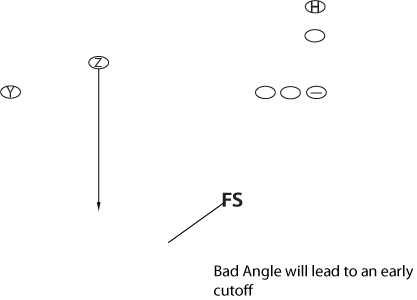
POOR ANGLE


This is the proper push angle. He should be at point with this type of leverage once the #2 WR pushes man coverage from the FS. This angle (if maintained) will allow the FS to play inside and vertical routes. A bad angle is a common mistake that many FS's make when first learning.


There might not be to much difference to the two angles at first, however the poor angle will get the FS in trouble if he gets an inside route (post or dig) from the #2 WR.

There is not as much of a problem if the # 2 WR runs a vertical route, but inside routes will be a problem. The aiming point of his angle should be past the cutoff point. The cutoff point is the point on the field where a WR will make his breaks inside or outside. It is usually at a distance 10-15 yards past the LOS. The diagram below will show the problem with redirecting from a bad angle.


This angle will make it too easy for the WR to beat the FS inside. From this point the FS will be out of phase in a chase position with no inside help. This is not middle field coverage. In this coverage inside routes must be properly leveraged to avoid giving up the big play.

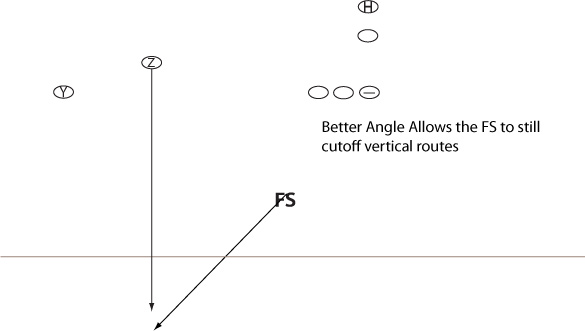
PROPER ANGLE

With the proper angle the FS will have adequate time to redirect and leverage both types of inside breaking routes.


The FS has more inside leverage on this coverage, and can see the route break-off with plenty of room to to allow for the proper recovery. This is the players main priority. It might make it harder to play corner routes, but he should have help from the corner there. This is a timeless football principal: LEVERAGE THE BALL TO WHERE YOU HAVE HELP.

This angle has benefits for the vertical route as well. If there is a speed mis-match, the FS has a better angle to cutoff the deep route.

This shows the FS cutting off the WR at the appropriate place on the field. There is still a chance the WR can cut inside but routes that deep are uncommon, the FS will have more time to recover, and the QB will probably thrown the ball the time the route gets this deep.

Below is some video of the proper angle and technique on a push. The FS is playing the TWINS WR's on the defensive left.


Even though the WR makes a break past the typical breaking point the FS should not worry too much about getting beat at this depth.

Tuesday, April 20, 2010

Quick Thoughts- Determining Coverages for a Defensive Scheme

The pro-I, wish-bone, and wing-t teams are not as common as they were in the 90's. Despite the fact that the spread is the current trend, high school defenses will still see a form of one of these run-offenses 2-5 times a year (sometimes more depending on the area). Good spread offenses force defenses to vary their coverage to keep themselves from getting exploited all day. The spread, due to it stress on spacing forces defenses to be conscious and aware of the windows and pass vulnerabilities that a coverage entails. While, traditional run offenses attacked coverages by the virtue of the coverage's force rules and run fits.

For example, lets consider squat/halves coverage (cloud force).

PRO-I TEAMS

Vs a squat corner many teams might attack the corner by utilizing a crack block on the safetyor backer coupled with a kick-out block by the full back on outside running plays. The pro-I coach is gonna use the wide positioning of the force player to create a wider running lane. This falls within the rules of the force player, fundamentally. A force player's job is to turn the ball back inside, but the angles the WR will have on the crack on the Safety or backer, and the fullback will have on the corner make this an excellent adjustment to squat/halves coverage.

SPREAD TEAMS

Spread teams don't think about run force vs squat/halves coverage as much as they think about pass coverage. This holds true for the run-heavy spread teams. Spread coaches, advocate "2-beaters" as the way to attack the coverage. Smash routes, fade/speed-out, and 2 outside verticals with a middle of the field split (post) route are just some the popular plays to attack squat/halves coverage.

THE MAIN POINT

No matter if you are facing mostly run heavy offense with only two wide-outs on the field or spread offense based from 4-wide formations; you are going to have mix up your coverages. Defenses facing the running sets are going to need a method to mix-up their run fits, and teams that face spread offenses are going to have to mix-up their pass zone responsibilities.


ORGANIZING COVERAGE

So of you reading, might be thinking," this is obvious! " Well, it is. But to what extent and in what way? Many coaches claim to be "Cover-2", "Cover 3", "Cover-4", "Man", or "Robber" coaches. Everyone has a coverage they like best and have bought into fully. However, seeing defense in this way limits the ability to mix it up, by making the idea of mixing up coverages scary.

The toughest dilemma for coaches is the goal to commit to getting good at one thing, versus limiting their effectiveness at that one thing in order to make time (room) for other things. The old phrase "Jack of all trades and master of none" is the hallmark phrase of this philosophy.

The mental block for coverage determination is the way we view coverage. Brophy's article about Nick Saban's Middle Field Coverage describe a great way to view coverage.

When you get down to it, there are really only two types of coverages in Saban's world;
  • middle of the field safety
  • split-safety coverage
When you teach a quarterback to read a defense, THIS is, afterall, what you teach him. From there, you can have 3 types of defenses;
  • man to man
  • zone
  • pattern match (after pattern distribution)

There really are two main forms of coverage.
1. Middle Field
2. Split Safety

Excluding man variations, which should be part of any team's coverage system, zone coverage falls into these two categories. Offenses have a general plan to attack each coverage type.

MIDDLE FIELD

Coaches will attack the stress player responsible for flat/force and the middle field safety. The vulnerabilities in this coverage are the seams and intermediate windows of the flat/curl areas. 4-verticals will stress your seams, and curl-flat and vertical-dig combinations will stress your flat/curls defenders.

SPLIT SAFETY

On pass coaches will attack the Middle of the Field. Squat/halves, quarters, and robber coverages are all susceptible to plays that attack the middle of the field. Split Safety coverage offers benefits that middle field coverage does not. It can provide better coverage on vertical/deep routes (exception is squat/halves) and more effective coverage on intermediate routes. However, the nature of split safety coverage allows offenses to run post routes that attack the middle of the field. This route is easier to throw and execute than deep vertical routes.

DETERMINING COVERAGE SCHEMES

Whether you are a Split Safety or Middle Field coverage coach, you cannot stay in just one of them. Obviously, if you have a talent advantage versus the opponents you play, you can possibly get away with it. But all things equal, good coaches are gonna exploit you. You have to use a favorable mixture of coverage calls to put the play-caller in a lose-lose situation. The economic concept of game theory can provide ideal ratios to optimize coverage calls. However, most of us don't have the time nor desire to calculate this. There is an easier way.

Step one is to recognize the vulnerabilities of your coverage. If you run split safety coverage 90% of the time, it is unreasonable to complain about people killing you on the post. No matter how well you teach your techniques, the natural advantage of attacking the middle of the field versus split safety coverage will be enough to get you burned more times than acceptable. On the other hand, it would be unreasonable to complain about intermediate routes and 4 verticals killing you in middle field coverage. The same reasoning applies to this.

Step two is to determine what play call ratio you ideally want to use and what ratio of time you will dedicate to practicing each concept. Some people will be more in favor of split safety coverage and others middle field. Whichever you choose, it is in you best interest to at least in concept involve adequate time for the other.

Remember the benefits and weaknesses of each. Fundamentally, using each one gives you a solid base to defend against offenses. In addition to this, properly mixing the two coverage types into your play calls, allows you to put more pressure on the offensive play-caller by making him guess whether you will be in middle field or split safety coverage.

CONCLUSION

This might ruffle some feathers, but this is just something I have observed. I have seen many defenses get burned by being too one-dimensional in their coverage scheme, and witnessed offenses get stuffed by less-talented teams that mix up the two concepts effectively.

Sunday, April 11, 2010

Defending the Counter- GT Part I

The counter is a staple plays that is run across many offensive philosophies. It is the hallmark of angle blocking teams. It can cause numerous problems for the defense, and put tremendous pressure on the d-line and backers. Stopping it is a priority for most teams, whether it is run from the I, wing-t, or spread. Defending it well requires sound alignment, gap-control, and a keen understanding of run-fits. The first step to defending it, involves understanding what the play is designed to do and what key things must happen in order for the offense to execute the play effectively.

STRATEGY OF THE COUNTER-GT

The counter blocking assignments are simple. One player is assigned to kick-out an edge defender (most likely a DE), another is designed to seal a linebacker, and the rest block down and away from the play. The backs job is to run between the kick-out and seal blocks.

The rules for the blocking are quite simple. The biggest thing the offense must determine is which player will be kicked out.

The key block in the play is the Double team of the play-side defensive tackle. Whether the tackle is a 3 or shade-nose makes no difference. The goal of the offense is to blast this player backward into the backside linebacker. The aiming point for the double team is to take the d-tackle past the center. This accomplishes two goals. One, it walls off the backside backer from pursuit, and two, it widens the running lane for the back and stresses the play-side defensive end and linebacker.


If the offense can create the above situation, the defense is in trouble. Determining how to defend the counter is irrelevant. Deciding between squeezing and spilling will make no difference, because the play is gonna gain yards period. Squeezing occurs when the "kick-out" defender squeezes down the line (with the down-block) and makes contact with the guard, keeping his outside shoulder free. The idea in a squeeze is to condense the running lane and push the ball to the linebackers. However, if the double team is able to push past the center the running lane cannot be condensed adequately.


Here the DE does a good job of squeezing, however the running lane is too large because of the double team. The back has enough room to make a cut off the seal on the linebacker. The backside backer cannot help stop this.

Spilling involves the DE and backer essentially trading responsibilities. The DE's goal is to get inside the kick-out and spill the play outside where the backer can make the play. Even with a good spill the counter can still go, if the double team pushes the d-tackle past the center.

Even on a good spill the DE has to much ground to cover to properly play inside the kick-out. The back simply needs to hug the line of his center and double team. The Seal block can easily get the linebacker despite the spill.


DEFENDING THE COUNTER

Handling the Double-Team

This might seem obvious to the typical reader, but is the most important principal when defending the counter. DO NOT ALLOW THE DOUBLE TEAM TO GET MOVEMENT ON THE D-TACKLE! This is a must, don't be stubborn about it. If the O-line is strong enough to drive your D-Tackle back, and no technique can prevent it, then have the tackle cut the linemen and create a pile. You cannot allow the offense to put stress on the play-side defenders.

Run Fits

Once you take care of the double team, you can begin to formulate a strategy of how you are going to defend the counter with your play-side defenders. The main ways are to squeeze and spill. Prior to determining those two techniques, it is important to know how your players will fit into the run. The basic run-fits are detailed below:

(these can change slightly when spilling if the Tackle runs around the guard)

Versus any kick/seal play the two offensive blockers create three running lanes or "gaps". A lane on the outside of each of them and one lane in between them. The idea for the offense is to ideally create an open lane in between them. For the defense, you must be able to place defenders in a position to defend these three areas. If you do not have these three covered the offense is gonna have a running lane. Here is an example of the run-fits if the defense chooses to squeeze. (More on the squeeze will be discussed in part 2)


Using this framework, it should be easy to diagnose the problem that occurs when the double-team pushes the d-tackle past the center. Lane #3 is undefended.

CONCLUSION

This is just an introduction into defending the Counter-GT. In this section, I talked about the goals of the offense, the most important priorities for the defense, and the principals for defending the play on the play-side. In part II I will go more in depth into the techniques and principals involved in squeezing an spilling.